
Co-production impact
Co-production impact content – we suggest starting with this document. It contains the definitions of key terms and overall guidance with an example.
Download PDFThis website will offer limited functionality in this browser. We only support the recent versions of major browsers like Chrome, Firefox, Safari, and Edge.
Published: April 2024. Updated April 2025
This resource is designed to provide insights into how to identify the difference that co-production is making in your work. After learning from previous research and speaking to people working in co-production and people with lived experience, we learnt that there are three key areas within impact that are the most important While the focus is on understanding impact, we have included sections on co-production achievements (short-term outcomes), benefits, feedback and evaluation of the process. We provide a definition for each of these sections to help you choose what you need most and get the right information.
This resource is designed to support co-production groups, people working in social care, and organisations who want to show the impact of co-production and who want to have conversations with and include people with lived experience in the impact assessment process. The resource offers a more accessible version of impact assessment with information about how to tailor approaches to fit your specific needs.
This resource was developed with the support of individuals with lived experience and co-production workers. We thank all individuals from the Proactive Community who took part in the steering group and all members of the SCIE Fliers co-production group and SCIE’s co-production steering group for their contribution.
Co-production impact content – we suggest starting with this document. It contains the definitions of key terms and overall guidance with an example.
Download PDFContains an easy-read summary of the impact section to be used by facilitators to include people with lived experience in the impact assessment process.
Download PDFThis Theory of Change (ToC) guidance template provides more detailed guidance on each step of the impact assessment.
Download PDFA resource designed to help individuals and teams in your organisation to create a plan for assessing impact.
Download PDF
Impact is the major change that is achieved towards the end of the process. It is the main objective that everyone is working towards.
Go to impact sectionAchievements that happen along the journey towards impact. It can also be called short-term outcomes.
Go to achievements sectionThe benefits of people taking part in co-production.
Go to benefits sectionEvaluating and reflecting on the process to learn and improve co-production.
Go to evaluation section
There are many ways to define impact, but essentially impact is the key change that is achieved towards the end of a journey to develop projects, services, policies, or anything that is being co-produced.
For this resource, we are using a definition that forms part of an approach called the Theory of Change. This is a framework that helps to understand how projects and organisations can produce impact and make positive changes in society.
Within the Theory of Change, impact is understood as the main change that happens and remains even after the co-production activities have been completed. This means that impact is the goal that everyone involved in a particular piece of work is aiming for, and it usually takes collective effort and time to be achieved.
This resource focuses on understanding the difference co-production makes when compared with not doing co-production, as opposed to a project’s task or a service’s impact more widely.
Showing the changes that co-production makes is key to being able to show its importance and to make a case for co-production to be prioritised, expanded and sustained. It is particularly important for attracting funding, as funders usually like to know the impact that their support will have on organisations, communities, and people’s lives. Demonstrating impact is also important to show the government and other organisations the value that co-production can add to social care and make a case for co-production to be prioritised.
“There is a human and a business case behind impact, and it is important to understand impact as it tells us what is working and what is not working, particularly when we have to demonstrate impact and show the positive changes.” – Isaac Samuels, Co-chair of the National Co-production Advisory Group (NGAC)
Co-production can happen in many forms, it is a process that should be tailored to individuals’ needs and there is no strict recipe for it. The same applies to understanding the impact of co-production. Different initiatives will pursue different types of impacts, sometimes larger and long-term, other times smaller and short-term. For these reasons, we have divided this resource into four sections so that you can access what is most relevant to you.
Why Theory of Change?
The Theory of Change is a good way to break down impact into more manageable pieces. While not all organisations and co-production groups use Theory of Change as a base for their work, it can still be used as a framework to help understand how the different parts of the project are linked to impact and how to identify the positive changes that are happening during the journey towards impact.
How does it work?
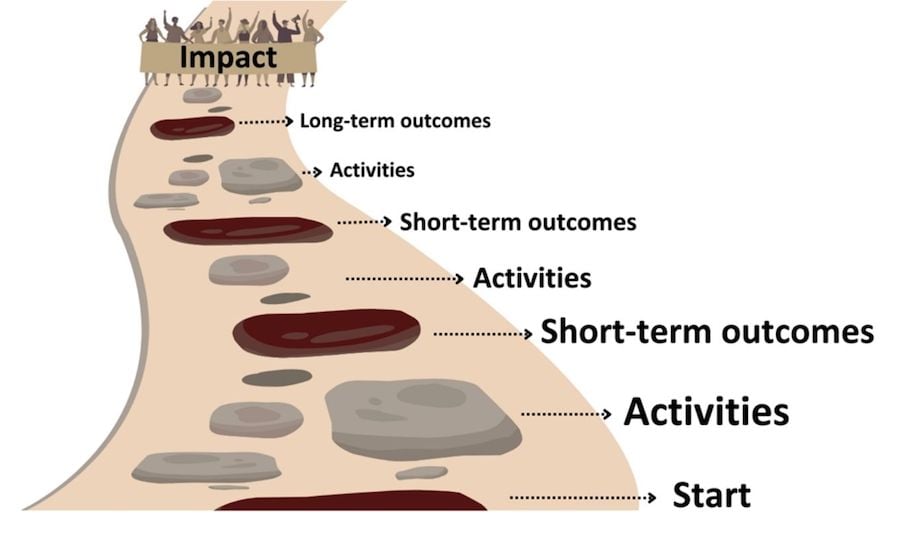
There are three essential elements that we would like to highlight: impact, outcomes (short and long-term), and activities. Activities and outcomes are the stepping stones that will form the pathway towards the impact, as illustrated below.
Impact
Impact is the key change that is achieved towards the end of the journey and is often part of an objective that all participants are aiming to reach. The Theory of Change can be helpful to break down that journey into various elements and help us to understand where we are and where we want to go. In some cases, a Theory of Change can also be helpful to show how far we have come even though the journey to impact is not completed. Many things are achieved and learned along the way that are essential to pave the way towards impact, but they also have a significant value on their own, to anyone involved in the work. We call these outcomes.
Outcomes
Outcomes are achievements, or positive changes, that happen along the way and are a result of co-production. While impact is the main change to be achieved, outcomes are the stepping stones that form the pathway to achieve impact. It includes, for example, the learning, the partnership and relationship developed, and the development that people and organisations achieve.
Activities
These are the activities that are planned and delivered with the intention of achieving a needed outcome to move a project towards its desired impact. It can include, workshops, meetings, training sessions, or anything that is part of the co-production activities.
NPC – Theory of Change in ten steps
NPC – Creating your own theory of change
Other co-production resources
Co-production Collective – Impact Report 2023
SCIE and TLAP – How to do co-production
SCIE – Examples of co-production
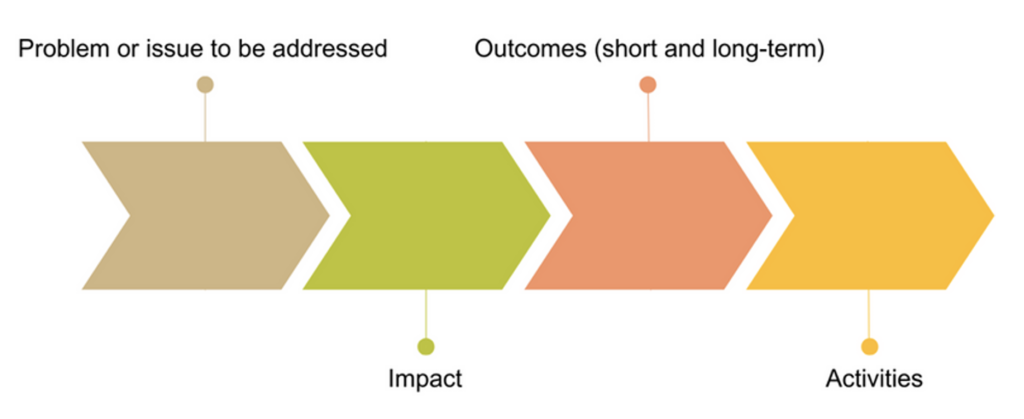
The Theory of Change is a good way to break down impact into more manageable pieces. It can be used as a framework to help understand how the different parts of the project are linked to impact and how to identify the positive changes that are happening during the journey towards impact. For this, we propose an exercise to separate two types of impact: project impact and co-production impact. This is a process that requires reflection and while there is no one single way of doing it, the below structure can provide a starting point.
We first start by defining the issue or problem that needs to be addressed and what impact is expected to be achieved. We then work backwards, thinking about the other elements that will form the pathway towards the desired impact.
For further details, access the guidance template.
This will define the direction of the project and will shape all other elements. It is important that this process is co-produced with individuals experiencing the issue to ensure that both the challenge and intended impact are relevant.
The targeted impact should be directly related to the challenge and can also be seen as a solution to the challenge. From this point, it is important to differentiate the project impact from co-production impact. This will help to identify with more clarity the difference co-production is making.
See section 1 in the guidance template for further information on how to define a targeted impact and identify the challenge or issue.
These can be described as a breakdown of the impact that will form a path towards the final goal. It will make the impact look realistic and achievable by dividing the journey into smaller parts. Identifying outcomes can be helpful to map co-production achievements even at earlier stages of the process when the impact is still far away but positive changes are already happening. Outcomes can also be defined using the making it real framework. Access our webpage for examples of ‘I and We’ statements.
See sections 2 and 3 in the guidance template for further information on how to define outcomes along with ideas on how to assess them.
In this part, we identify what needs to be done – all actions, tasks and interactions – that will lead to the above outcomes. It is key that all activities have a clear objective that is directly related to the desired outcome.
See section 2 in the guidance template for further information on how to define activities and how they are connected to outcomes.
This will define the direction of the project and will shape all other elements. It is important that this process is co-produced with individuals experiencing the issue to ensure that both the problem and intended impact are relevant.
The targeted impact should be directly related to the problem and can also be seen as a solution to the problem. From this point, it is important to differentiate the project impact from co-production impact. This will help to identify with more clarity the difference co-production is making.
To make the day centre how people would like it to be, that will match their needs and preferences, and that more people will be happy to use.
See section 1 in the guidance template (PDF) for further information on how to define a targeted impact and identify the problem or issue.
These can be described as a breakdown of the impact that will form a path towards the final goal. It will make the impact look realistic and achievable by dividing the journey into smaller parts. Identifying outcomes can be helpful to map co-production achievements even at earlier stages of the process when the impact is still far away but positive changes are already happening.
See section 2 in the guidance template (PDF) for further information on how to define activities and how they are connected to outcomes.
Evaluation Netway – Logic Model definitions and guidance
Evaluation Support Scotland – Evidencing genuine co-production in the third sector

Achievements are short-term outcomes that can be understood and assessed individually, separately from impact. While impact is a longer-term journey, assessing achievements can help to acknowledge progress and showcase positive changes that are happening on a day-to-day basis.
It can include – but not restricted to – things that are learnt, such as increasing people’s awareness, and improvement in relationships between individuals and stakeholders.
Achievements are the outcomes that form the pathway towards impact. However, if your choice is to focus only on achievements instead, you can look at each achievement individually and assess specific parts of your co-production journey.
Co-production is a journey which needs to be embedded in practices and often relies on a change of culture. Therefore, celebrating achievements supports engagement and interest from key stakeholders and allows you to report on progress and positive changes regardless of where you are on your journey. In other cases, achieving impact is restricted by challenges that are beyond the control of co-production such as interruption of funding, changes in leadership priorities, and changes in partnerships. In these cases, identifying achievements can be useful to demonstrate the difference that co-production is making despite the external challenges.
To help better understand and describe the progress of each achievement, a breakdown with a brief description of the activities can be developed. This can also be helpful to define a short-term pathway of the achievement for more detailed reporting if relevant. See example below.
Project achievements
Developing an accessible equality, diversity and inclusion internal policy document.
Activities
Ideas to assess achievements
The principles of the Theory of Change can be helpful for assessing achievements. Although the objective here is not to assess impact, the Theory of Change can be used as a framework to identify achievements in a structured way helping you better understand each achievement individually. You can use the guidance template to identify activities and their corresponding short-term outcomes. This can be done independent of whether you have a defined path for impact and how far in the path your project is.
Section 2 in the guidance template (PDF) can be used to support you in defining achievements (short-term outcomes).
Resources
Mencap – Setting outcomes: A guide
Routledge – Evaluating the outcomes of co-production in local government
TLAP – Co-producing an outcomes framework
National Collaborating Centre for Mental Health – Working Well Together: Evidence and tools to enable co-production in mental health commissioning (contains a section on outcomes assessment (pp.30-32))
Challenge, issue, or improvement needed
People diagnosed with dementia didn’t have options for tailored support and had to face challenges alone.Targeted impact
Project impact – to create a network of peers across the county led by people with dementia to provide long-term peer support for people with dementia. Co-production impact – to make the peer support groups relevant to the needs of people with dementia and carers, creating a space for mutual support, socialisation, local influence and learning.Outcomes
Project outcomesProject activities
Challenge, issue, or improvement needed
The carers assessment process was hard to understand, the form was too complicated, individuals felt that questions were not easy to understand, and it was not clear why some information was needed.Targeted impact
Project impact – to review and make improvements to the carers assessment form, increasing accessibility and relevance so it is not a tick-box exercise. Co-production impact – to make the form easy to understand, with clear language and structure, and relevant to carers so they are engaged with the process and understand the reasons for providing the information asked.Outcomes
Project outcomesChallenge, issue, or improvement needed
People with learning disabilities don’t have a place to go to make friends, learn new things, have a good time, and feel valued.Targeted impact
Project impact – to create a day centre for people with learning disabilities. Co-production impact – to make the day centre how people would like it to be, that will match their needs and preferences, and that more people will be happy to use.Outcomes
Project outcomesNew Philanthropy Capital – Theory of change in ten steps
New Philanthropy Capital – Creating your own theory of change
Evaluation Netway – Logic Model definitions and guidance
Evaluation Support Scotland – Evidencing genuine co-production in the third sector
Other co-production resources
SCIE and TLAP – How to do co-production

Achievements are short-term outcomes that can be understood and assessed individually, separately from impact. While impact is a longer-term journey, assessing achievements can help to acknowledge progress and showcase positive changes that are happening on a day-to-day basis.
It can include – but not restricted to – things that are learnt, such as increasing people’s awareness, and improvement in relationships between individuals and stakeholders.
Achievements are the outcomes that form the pathway towards impact. However, if your choice is to focus only on achievements instead, you can look at each achievement individually and assess specific parts of your co-production journey.
Co-production is a journey which needs to be embedded in practices and often relies on a change of culture. Therefore, celebrating achievements supports engagement and interest from key stakeholders and allows you to report on progress and positive changes regardless of where you are on your journey. In other cases, achieving impact is restricted by challenges that are beyond the control of co-production such as interruption of funding, changes in leadership priorities, and changes in partnerships. In these cases, identifying achievements can be useful to demonstrate the difference that co-production is making despite the external challenges.
To help better understand and describe the progress of each achievement, a breakdown with a brief description of the activities can be developed. This can also be helpful to define a short-term pathway of the achievement for more detailed reporting if relevant. See example below.
“From a lived experience point of view these are good examples of achievement, which ultimately leads to better outcomes for individuals.”
Isaac Samuels, Co-chair of the National Co-production Advisory Group (NCAG)
Co-production achievements (short-term outcomes)
Project achievements
Activities
Co-production achievements
Activities
The principles of the Theory of Change can be helpful for assessing achievements. Although the objective here is not to assess impact, the Theory of Change can be used as a framework to identify achievements in a structured way helping you better understand each achievement individually. You can use the guidance template to identify activities and their corresponding short-term outcomes. This can be done independently of whether you have a defined path for impact and how far in the path your project is.
Section 2 in the guidance template can be used to support you in defining achievements (short-term outcomes).
Mencap – Setting outcomes: A guide
Routledge – Evaluating the outcomes of co-production in local government
TLAP – Co-producing an outcomes framework
National Collaborating Centre for Mental Health – Working Well Together: Evidence and tools to enable co-production in mental health commissioning (contains a section on outcomes assessment (pp.30-32))

These are the benefits to all individuals involved in co-production and can include aspects of their personal development, how they feel, and how they do things. It may include individuals feeling more valued, having an increase in confidence, an increase in independence, a better sense of belonging to a group, and developing knowledge and awareness.
Understanding the benefits of co-production is key to demonstrating the positive changes that co-production is making in people’s lives. In co-production, it is essential that the people involved are getting something valuable out of the process and that taking part is relevant to their lives. Moreover, professionals, practitioners, and policymakers, as well as service providers and organisations, also benefit from co-production.
To be able to report on the benefits is important and shows the relevance that co-production has for individuals, professionals, and organisations. It is a way to demonstrate that people learn, develop skills, build relationships, improve ways of living and working, and gain confidence and independence. Recognising these benefits enhances the case for why co-production matters and why we should have time and funds allocated specifically for co-produced efforts.
To understand the benefits of co-production to individuals it is key to develop a structured way to hear about their experience and the benefits they gain from the process. Each individual, or group, will have their preferred ways to provide their views and it is important that they are able to make such a decision.
When defining outcomes and creating a pathway towards impact, some benefits of co-production can be defined as outcomes to be achieved within that pathway. If that is the case, you can follow the guidance for creating outcomes and include these within your pathway to impact.
See sections 1 and 2 in the guidance template for further information on how to define outcomes and identify the challenge or issue.
Co-production Collective – The value of co-production (contains examples of benefits of co-production)
SCIE and TLAP – Co-production what it is and how to do it (contains a section on benefits of co-production)
SCIE and TLAP – The difference co-production makes
Community Fund (an example of assessing and reporting co-production benefits)
Health Watch Suffolk – The value of co-production within health and social care (literature review on values and benefits of co-production)
Expert Link – The power of co-production: Unlocking unexpected benefits for participants
University of Gent – Benefits and risks of coproduction: a preliminary literature review
Feedback and evaluation will provide a good insight into whether activities are achieving their objectives and why people engage or do not engage in activities. It will give a general sense of the quality of the activities and will help to make changes to ensure they are effective and will contribute to generating the expected outcome.
Collecting feedback is crucial for learning and improving the co-production process. It will give you insights into how individuals are experiencing the co-production process, allowing activities to be tailored to individual’s needs and preferences, which can help to make the overall process relevant, suitable, and engaging.
There are many ways to collect feedback and it is important an approach is chosen based on individuals’ needs making sure it is accessible and suitable to them. Below we suggest a few approaches as a starting point.
IPC Brokes – Co-production checklist (contains a section on feedback)