
By Gerard Crofton-Martin, Interim Chief Executive at the Social Care Institute for Excellence (SCIE)
For decades, social care reform has been characterised by political ambition followed by retreat. Successive governments have recognised the urgency of change, only to falter when confronted with the difficult questions of funding and delivery.
The Prime Minister’s commitment at Labour Party conference to end this political ‘capitulation in the face of the social care crisis’ is therefore a watershed moment. His ambition for a person-centred, high-quality and home-first National Care Service offers a welcome opportunity to break this cycle.
The real test will be whether government can create the conditions for reform to succeed. Evidence from England and internationally demonstrates that successful reform depends on funding and helping people and organisations develop the skills and capacity they need to deliver high-quality care.

Sustainable funding is fundamental. Without financial stability, local authorities and care providers will continue to prioritise immediate pressures over prevention, innovation and long-term improvement. A home-first approach, for example, requires investment in community-based support that helps people maintain independence, rather than waiting until their needs reach crisis point.
Equally important is a skilled, supported and valued workforce. The Health and Social Care Secretary’s workforce announcements at the Labour Party conference represent meaningful progress. The challenge now is to embed these commitments within a wider programme of workforce development, leadership and system improvement, so that better conditions for care workers translate into better experiences for people drawing on care and support.
Effective reform also depends on better data and digital infrastructure, enabling services to coordinate support, understand outcomes and tackle inequalities. A person-centred system must be one that people can navigate, with accessible information, advice and advocacy that allow them to understand their rights and exercise meaningful choice and control.
None of these elements can be delivered in isolation. Together, they determine whether the promise of a National Care Service translates into better care experiences and outcomes.
One weakness of previous reforms has been the disinvestment in national improvement infrastructure to support this change. Social care requires long-term investment in the evidence, leadership, guidance and implementation support needed to translate national policy into local practice.
The Prime Minister has opened the door to a different future for social care. The Casey Commission has the leadership and momentum to design a National Care Service the public will support. Delivering it will require more than political resolve and a sustainable funding settlement. It will require sustained investment in the foundations that make high-quality, person-centred care possible.
By Baroness Glenys Thornton, Chair of the Board at SCIE
It is with great pride that SCIE has now reached the significant milestone of being in existence for 25 years. Whilst the social care landscape has been through significant challenges and changes, our vision as a charity remains steadfast in that we will always strive for a society to enable everyone who draws on social care to live fulfilling lives.
What a moment to be marking this milestone. After years of debate about the future of social care, there is a renewed sense of ambition and momentum for meaningful reform. The Prime Minister’s recent commitment to a fully funded National Care Service in the next Parliament, alongside the accelerated Casey Commission and plans to improve pay and conditions for care workers, signals an important opportunity to reshape care for generations to come. For those of us who have long championed better care and support, this is a welcome moment of possibility, and one we must seize together.

Of course, the scale of the challenge remains significant. With growing demand, pressures on the workforce and local services, and persistent inequalities in access to care, the need for change has never been clearer. As reforms across health, local government and housing gather pace, we have a real opportunity to build a more joined-up, preventative and equitable system. One that balances national consistency with local flexibility, and above all puts people’s choices, experiences and aspirations at its heart. The test of success will be whether these ambitions translate into tangible improvements in people’s everyday lives.
For 25 years we have brought together evidence, lived experience and policy, translating them into daily practice; working with Government, local authorities, people with lived experience, care providers, academics and the voluntary sector, to drive improvements and innovation. Originally established by the last Labour government to improve the quality of care and support across England, we have delivered this support through our 4 offers of innovative consultancy, expert training, extensive resources and evidence-based insights. But while we can reflect on the past and how much we have achieved, our 25th year sees us sharply focused on our unique role in turning best practice insights and lived experience into practical change, to help shape the National Care Service of the future.
SCIE has evolved alongside the sector, from providing trusted guidance and resources to becoming a leading improvement partner, supporting innovation, strengthening practice and helping organisations navigate change. From supporting the implementation of the Care Act 2014 to advancing co-production, digital innovation and care equity, we have continued to adapt our expertise to meet the sector’s changing needs. As we look ahead, our ambition is to build on this legacy: championing evidence-led improvement, bringing together the right voices and helping turn the promise of reform into better, fairer care and support for everyone.
Over the coming weeks and months, alongside our new refreshed branding, we will share reflections on our past and how our trusted expertise and knowledge can be a crucial part of the future social care landscape.
I would like to thank all of our partners, funders, supporters, and our amazing team of staff and lived experience members; our success over the last 25 years is because of you all, and we look forward to continuing to work with you and alongside you for the future to improve lives, collaborating and innovating in care.
By Carrie Bower, Practice Development Consultant Trainer at SCIE
Domestic Abuse Awareness Month, recognised each October, is dedicated to raising awareness of domestic abuse, challenging common myths and misconceptions, reducing stigma, and encouraging open conversations that help people recognise abuse and seek support.
When we talk about domestic abuse, much of the conversation focuses on an event or a crisis. What if, instead of asking “What’s happened to this person?”, we also asked, “What has this person lived through?”
One of the things I have learned from working alongside older adults is that abuse rarely exists in isolation. It sits alongside oppression and discrimination, bereavement, ill health, caring responsibilities and generational norms.

Sometimes abuse has been present for decades. For some older victim-survivors, the abuse we see today may be part of a pattern that began many years ago. For others, it may emerge later in life as circumstances change. Retirement, ill health, cognitive decline, changing family dynamics or increasing dependency can all create opportunities for someone to exert power and control.
A crisis may bring someone to the attention of services, but the story often starts much earlier. That is why understanding the life course matters. If we focus only on the presenting issue, we risk missing the bigger picture. Too often, professional conversations focus exclusively on needs and risk. Of course, understanding these are important, but when we focus only on deficits, we miss something equally important.
So, as professionals, we need to consider the following.
Strengths
The older adults I have met throughout my career and personal life have survived experiences that would be unimaginable to others. They have developed strategies to keep themselves safe, protect their families and navigate systems that are not always designed with them in mind.
That does not mean they have not been harmed. It means they have survived.
Being trauma-informed
We must acknowledge that the impact of abuse is diverse, while also recognising the strengths, skills and wisdom that adults bring from their lived experience.
Building relationships based on trust
Understanding the experiences of older victim-survivors: a thematic analysis from Dewis Choice highlights the importance of creating relational safe spaces for older victim-survivors to have the space to tell their stories safely.
For many, trust takes time, and we need to be able to:
- listen deeply
- be comfortable with silence
- understand that disclosure is often a process rather than an event
- accept that trauma doesn’t always look the way we expect; we all carry biases about what domestic abuse looks like.
Often, the most important intervention is not a form, an assessment or a procedure. It is making somebody feel heard.
We know this also requires organisational support, and this is something to be raised as The Big Conversation on Care, being led by the Independent Commission on Adult Social Care, explores the future of adult social care. I believe trauma-informed practice has an important place in that discussion. Not as another initiative or piece of jargon, but as a way of understanding people’s lives. It sees histories, strengths, relationships and aspirations; adults whose experiences matter, and whose voices need to be heard.
For older victim-survivors of domestic abuse, that understanding can be transformative.
SCIE partners with organisations to anticipate and manage safeguarding risks, with expert-led insights, tailored training and co-produced solutions. Our safeguarding support is bespoke to you and your organisation, and our work is always evidence-based, using the latest and most rigorous insights about what constitutes best practice. Contact consultancy@scie.org.uk or training@scie.org.uk to find out how we can help.
By Peter Tsoukkas, Research Officer, Essex Autonomy Project, University of Essex, autonomy@essex.ac.uk
On 2 June 2026, the UK Supreme Court handed down its judgment in A Reference by the Attorney General for Northern Ireland (AGNI) [2026] UKSC 16. The judgment made two significant changes to the test for deprivation of liberty in care settings. First, it replaced the Cheshire West “acid test” with a multifactorial assessment of confinement; this is known as ‘the objective limb’ of the test for deprivation of liberty. Second, it recognised a new form of valid consent, available even to a person who lacks the capacity to make the decision in question. This is the so-called ‘subjective limb’ of the test. Both changes carry immediate and far-reaching implications for health and social care practitioners who must ensure protection for the liberty rights of people who draw on care and support across the UK.

I recently provided research and technical support for the National Mental Capacity Forum (NMCF) and the Essex Autonomy Project (EAP) to deliver two NMCF webinars addressing the AGNI judgment. NMCF is a joint initiative of the Ministry of Justice and the Department of Health and Social Care. It plays an important role in raising awareness of the Mental Capacity Act and in providing opportunities for continuing education and discussion among those who apply the Act in practice.
Interest in the two NMCF AGNI webinars was high, with 988 registrations for the pre-judgment webinar (25 March, 2026) and 981 registrations for the ‘Rapid Response’ webinar that was held shortly after the judgment was handed down (24 June, 2026). We were grateful that many registrants took time to respond to our optional registration questions. Their responses helped me understand how frontline health and social care professionals see the challenges arising from AGNI. The snapshot provided by this NMCF registration data can and should inform the development of post-AGNI guidance and training. The response from the workforce also suggests that, in at least one important respect, the frontline health and social care workforce was already a step ahead of AGNI.
The risks
The NMCF registration data show a workforce with serious concerns about the AGNI judgment. Before the ruling, NMCF affiliates identified one of the biggest challenges pertaining to the subjective limb: how do you tell the difference between a person genuinely consenting and a person who is merely going along with something they have little power to resist?
Webinar registrants, who were predominantly health and social care professionals who play a role in applying the Deprivation of Liberty Safeguards as part of their professional duties, distinguished assent from acquiescence, describing acquiescence as closer to learned helplessness (agreement given out of fear, institutionalisation, or a lack of power to say no), warning of the danger of mistaking acquiescence for consent. 58% of 914 respondents agreed that consent can sometimes be validly inferred from behaviour or demeanour, but 65% of 903 respondents warned of the risks in relying on merely tacit or passive consent in the absence of decision-making capacity.
After the ruling, the most dominant concern from frontline professionals pertained to the objective limb, and to the risk of losing independent oversight of care arrangements for vulnerable persons who may not expressly manifest their objections. This was the most commonly mentioned concern among 533 respondents. NMCF affiliates felt that self-funders and people without family or friends to advocate for them may be particularly exposed to this risk.
A further source of confusion was the comparison to detention in a prison cell. The multifactorial assessment calls for assessors to consider how far-removed care settings are from the situation of detention in a prison cell. Practitioners noted that some care settings may not resemble a prison cell but are in fact more restrictive than one. They expressed uncertainty about how to weigh this against the other seven factors in a multifactorial assessment.
Practitioners expressed concern that the multifactorial assessment runs the risk of inconsistent application and that the new standard might simply prove to be “too subjective” to apply safely.
The opportunities
The workforce also sees opportunities in the Supreme Court’s ruling. The replacement of the Cheshire West “acid test” with the multifactorial assessment could allow for narrower and more selective DoLS procedures. Respondents saw this as an important opportunity to ease the national backlog created by the acid test while targeting resources to the most sensitive and complex cases.
A snapshot from the workforce: hard cases
Perhaps the most useful information from NMCF affiliates came in response to our question about challenging cases. We asked registrants to describe cases in which they anticipated that they would struggle to apply the new AGNI standard. The responses provide a compelling test against which to assess emerging guidance. The tables below, prepared by the Essex Autonomy Project Research Team using thematic analysis, provide a typology of these reported hard cases. The tables are sorted between challenges that pertain to the ‘objective limb’ (confinement) and the ‘subjective limb’ (consent) of the AGNI standard for deprivation of liberty.
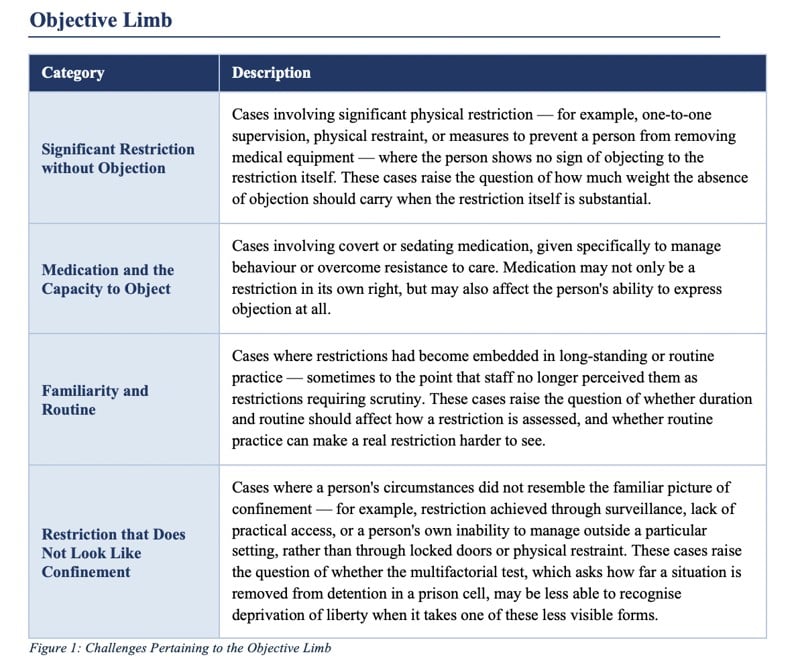
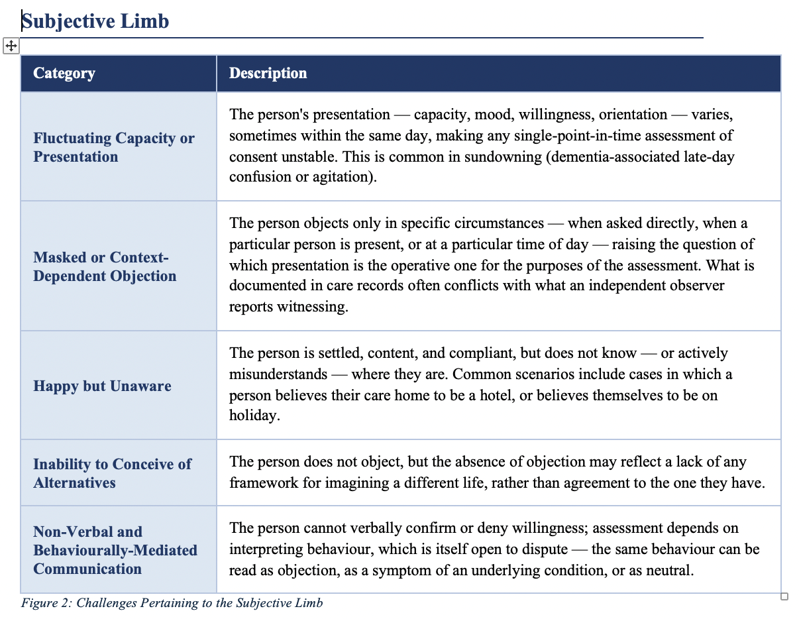
Practitioners consistently pointed to the need for guidance that would help health and social care professionals navigate these hard cases and emphasised the importance of repeating assessments and gathering evidence over time, as opposed to the assessment being a one-off judgement.
A workforce ahead of the curve
Those of us involved in the production of the NMCF webinars were struck by one piece of the registration data that seemed to show a workforce that was out ahead of the Supreme Court. One of the most-discussed elements of the ruling from the Court has been the recognition of a new form of valid consent.
In the context of Art.5 (ECHR) protections, the Court found that a person can validly consent to restrictive care arrangements even in the absence of decision-making capacity regarding those arrangements. This new form of consent has occasioned scepticism and concerns among the workforce, but on the basic question, the workforce seems to be on board with the Court’s perspective. Ten weeks before the ruling, 97% of 670 NMCF respondents agreed that a person who lacks capacity to decide where to live may still have a clearly identifiable will or preference about their placement or care arrangements.
About the author
Peter Tsoukkas is a Doctoral Candidate affiliated with Essex Autonomy Project, a research and public policy initiative at the University of Essex. In 2026, he provided research and technical support to the National Mental Capacity Forum to deliver a series of five national webinars for affiliates of the Forum. His own research focuses on the right of disabled persons to be included in the community. He has a background working as a frontline care worker in a small-scale group home.