
Introduction to leadership of self
The importance of critical reflection on our own practice is embedded in professional standards of behaviour within health and social care. Clinical (or practice) supervision makes an important contribution to such critical reflection through providing a safe and structured opportunity to consider feedback and other data regarding our practice. Demonstrating effective leadership similarly requires critical reflection on our interactions with others, how we have communicated a common vision and supported them to build on their strengths.
Self-leadership, or the ‘process of influencing oneself’, has therefore evolved as a field of study and practice. This considers how we can encourage ourselves to not only undertake those tasks which we find naturally motivating but also those tasks which are important but which do not have an intrinsic appeal.
Self-leadership has been linked in studies with individuals being more productive, more satisfied, and more successful in their work. Motivation to undertake less-appealing activities can come from us recognising how they can be associated with outcomes that we value, even if we do not enjoy the process itself. For example, some of us do not enjoy speaking in public, but recognising that this helps to inspire others and ensure there is common understanding can enable us to find the motivation to undertake what can seem a challenging task. Another strategy for self-leadership includes focusing on how we can contribute to completing a task or achieving an outcome rather than waiting for the intervention of an external influence or circumstance.
A third strategy for self-leadership is to imagine how others would experience us completing a leadership task or role to a high standard. This then enables us to recognise what is required and alter our behaviour to reflect this standard. Finally, giving ourselves a reward for achieving a challenging goal will provide additional motivation. This can be something as small as having a meal out or finishing work a little early – whatever we will appreciate as an experience.
Engaging with our values
Similar to professional practice, improving our leadership of self not only relates to our skills and knowledge, but also engaging with our values. Values are what we see as important in life, and are shaped by many influences – our upbringing, our professional training, our religious and political beliefs, our friends and networks, and by organisations. We may hold some values throughout our life but others may change through our life experience and changes in our perceptions. Values are incredibly powerful in dictating how we understand a situation and the actions that we believe to be appropriate. They also affect our emotions – when we are asked to undertake an activity that we see as in line with our values then this can result in greater motivation and satisfaction. However, being asked to engage with decisions or actions that we see as conflicting with our values will lead to internal conflict and feelings of stress.
Similarly, we are more likely to follow leaders who have similar values to ourselves and who also demonstrate this in their behaviour. If a leader suggests that they hold a value which we see as important but then acts in a way that seems contrary to this, then this will lead to disillusionment and disengagement from their vision. It is therefore vital that as leaders from strengths-based practice, we are clear on our values and remain true to these in our decision-making and actions.
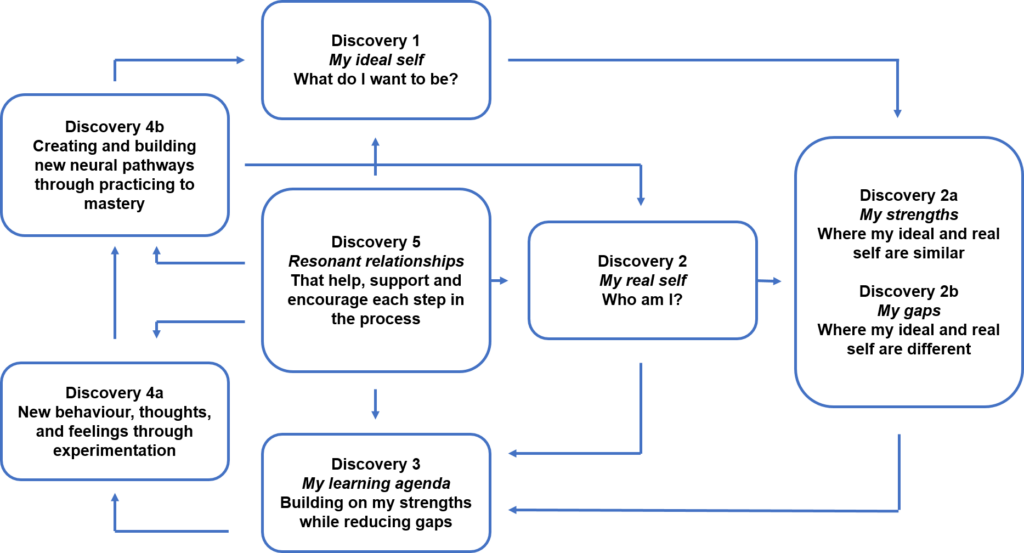
Leading better then involves us reflecting on what we do, why we do it (i.e. our values) and how we do it. Intentional Change Theory (Boyatzis 2006) outlines a reflective process through which we can change our behaviour, thoughts, feelings and perception. This involves a reflective cycle built around five discoveries about ourselves.
- The first is discovering who we want to be, i.e. our ideal self. This involves us having an image of what this future could be, believing that we can attain it, and having initial strengths than can be built upon.
- The second is discovering how we actually behave as leader. All of us become used to our own behaviours and develop a self-image that does not accurately reflect how others experience us. Only by being open to the realities of our leadership through seeking feedback from others and related data will we gain a true understanding of our leadership practice.
- The third discovery is identifying what development will be required for us to sufficiently build on our existing strengths, and giving ourselves permission to engage with related opportunities.
- The fourth discovery is to try out new ways of behaving in a real-life setting and to learn from the experience of this application. It is important that we undertake this experimentation in environments in which we feel safe – if not, there is a danger that the risk of embarrassments or failures may be too great.
- The fifth is discovering the relationships that will support us to move towards our ideal state and if these are not in place to develop the necessary community of practice. Such relationships provide feedback, interpretation, challenge and inspiration.
Development of strengths-based nursing
Pam Hubley, Vice President, Education & Academic Practice, and Chief of International Nursing at SickKids (The Hospital for Sick Children, Toronto, ON, Canada) shares their development of strengths-based nursing and the contribution of leadership to embedding values in practice.