
Adaptive leadership model
Background
Adaptive leadership is concerned with how people are supported to positively deal with change. Its focus is not primarily on the actions of the leader as such, but rather on how leaders can encourage and facilitate others to do what is necessary to adapt to the new circumstances. According to thinkers such as Heifetz (1994), such leaders engage in activities that mobilise, motivate, organise, orient and focus the attention of others. They also help others to reflect on their previous values, and where necessary to change these to respond to the new reality. Whilst formal authority such as a more senior organisational role can be a helpful tool for adaptive leaders, it is not seen as a pre-requisite and anyone can potentially inspire their colleagues to engage with the necessary ‘adaptive work’.
Main principles
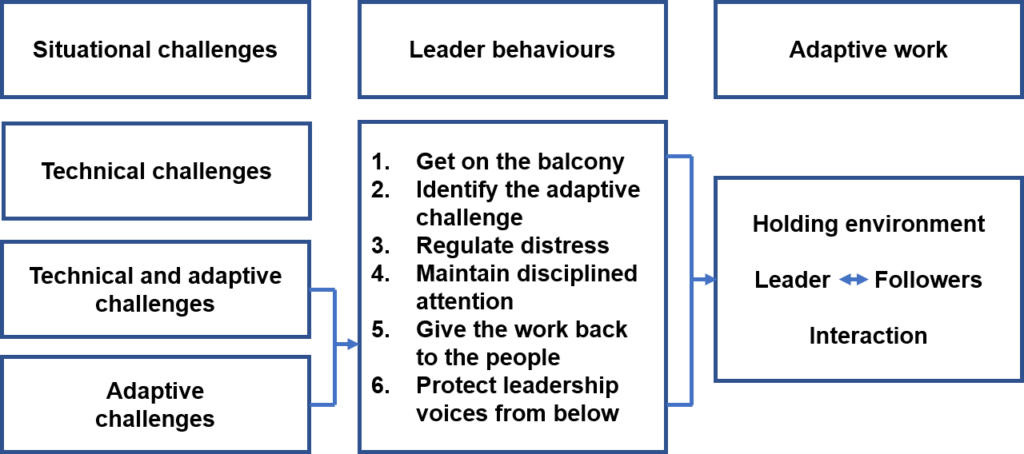
The model differentiates between ‘technical’ and ‘adaptive’ challenges. Technical challenges are those which are clearly understood and which can be addressed through known solutions. The skills and resources to solve such problems can be organised or obtained by the manager using their organisational authority.
Adaptive challenges are those which are not easily defined (i.e. we know there is a problem but do not fully understand what it is and its underlying causes), and for which the normal ways of working based on existing values are not sufficient. To address such challenges will therefore require those responsible to change their assumptions, beliefs, attitudes and/or behaviours. This is a much more demanding and active response than addressing a ‘technical’ issue. Some challenges may be part technical (i.e. we know how to do some of what is required) and part adaptive (i.e. some aspects are unclear and our response uncertain).
Figure 7: Model of adaptive leadership
Credit: Northouse, P. Leadership: Theory and Practice, Seventh Edition (SAGE Publications, 2016).
The Adaptive Leadership model suggests that there are six behaviours that leaders should demonstrate to help others to confront the challenges and the changes that may be required.
Implications for strengths-based leadership
Some aspects of moving to a strengths-based approach are known, for example opportunities such as supervision for reflection and assessment processes and forms that do not focus primarily on problems and deficits. Others are less clear, particularly in the pressured and resource-limited current context of health and social care. Furthermore, it can be very difficult for professionals to accept that their previous practice has not been experienced as strengths-based and there can be perceived value clashes between a need for organisations to be productive and the benefits of a more person-centred, relational approach. This suggests that adaptive work will be common for the individuals and teams seeking to demonstrate such practice. It also emphasises that anyone can potentially contribute to leading a response to a challenge or opportunity even if they do not have a senior position.
For more information
Adaptive leadership: Catherine Mangan
Watch On leadership (Ronald Heifetz, Harvard Kennedy School, 2019)