
ACDS Systems Leadership model
Background
Systems thinking was first developed in the biological sciences but is now widely applied in many fields of practice and academic disciplines. It emphasises that understanding the relationship between the components of a system is more insightful than studying the individual elements in isolation. Such systems are seen to be dynamic rather than fixed, with continual adaptation to respond to changes in the external environment. Complex adaptive systems such as health and social care services have diverse elements who have considerable ‘agency’ over their behaviour This means that the system is unpredictable and not easily controlled through management. Instead, systems leadership is proposed as the most effective approach to encourage the system to work more effectively.
Main principles
Researchers at the Cass Business School and Colebrooke Centre for Evidence and Implementation were commissioned by the Virtual Staff College of ACDS in 2012 to study systems leadership in practice. Their investigations included a literature review, interviews with systems leaders, and case studies within England and from international examples of systems leadership (Ghate et al, 2013).
They distilled their learning into six dimensions of systems leadership which leaders may find helpful to reflect on in relation to their own practice:
- Ways of feeling: System leaders should be driven by a strong set of personal core values based around the need to improve wellbeing and address inequalities.
- Ways of perceiving: System leaders need to seek to understand the bigger picture through listening to diverse voices and being open to challenge of their assumptions. This requires emotional engagement as well as intellectual effort.
- Ways of thinking: Due to the complexity underlying major issues, system leaders have to seek out new sources of information, and then be able to consider, analyse and respond to the insights that these produce.
- Ways of relating: Personal relationships and the ability to engage with others through respect and empathy is core to system leaderships. This is about honesty and openness, facilitating an authentic reflection of common values and the development of trust.
- Ways of doing: The emphasis for system leaders is not on ‘doing’ themselves, but rather facilitating others to feel encouraged, supported and trusted to take action. This includes supporting others to think more creatively about how to use existing resources and developing a convincing narrative that engages those across different sectors.
- Ways of being: System leaders demonstrate an overall way of behaving that demonstrates personal characteristics such as bravery and risk taking, personal resilience, and being willing to patiently take the long view.
Public service context, systems leadership and systems leaders – an integrated model
Improving outcomes for service users
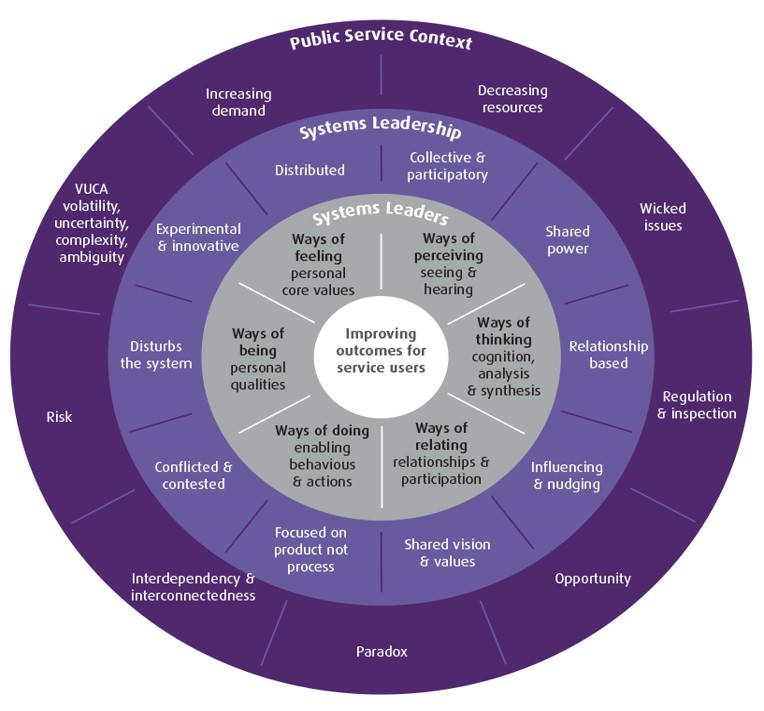
- Ways of perceiving seeing and hearing
- Ways of thinking cognition, analysis and synthesis
- Ways of relating relationships and participation
- Ways of doing enabling behaviours and actions
- Ways of being personal qualities
- Ways of feeling personal core values
- Collective and participatory
- Shared power
- Relationship based
- Influencing and nudging
- Shared vision and values
- Focused on product not process
- Conflicted and contested
- Disturbs the system
- Experimental and innovative
- Distributed
- Decreasing resources
- Wicked issues
- Regulation and inspection
- Opportunity
- Paradox
- Interdependency and interconnectedness
- Risk
- VUCA volatility, uncertainty, complexity, ambiguity
- Increasing demand
Implications for strengths-based leadership
Uncertainty and diversity of perspectives are the reality within complex systems and leaders must therefore be comfortable with more emergent approaches to change and to adapting their plans to respond to new information and insights. The leadership role is about developing constructive relationships across the system and facilitating contribution from others.
Systems leadership: Deborah Ghate
For more information:
- David Pearson talking about systems leadership (video) (SCIE).