
Staff employed within the system are squeezed between economic austerity and political hyperactivity, and as a result more and more interest is being shown in the skills needed to marry the political process to service delivery on the ground.
Political Leadership model
Background
In the previous sections we have outlined a number of leadership models that are important in the current context of health and social care leadership. However, there has been little focus on how to exert leadership to cope with external and internal political environments confronted by leaders and managers. As argued by Baddeley and James (1987) the rational, professional, bureaucratic elements of local government which are an important source of its reliability and strength, have encouraged leaders and managers to remain innocent of the need to become ’street-wise’ about what is afoot. As Sutherland (1986) has observed:
The importance of being a politically skilled leader is all the more important when considering the relationship between health and social care leaders and councillors. A number of challenges are reshaping local government and reshaping what it means to be a councillor. Councillors now have a crucial role in orchestrating local people, shaping local strategies and plans for places, and being a catalyst for driving community-led solutions to problems. What this means is that health and social care leaders need to be aware of and sensitive to the changing role of councillors.
Solving politically sensitive questions and problems
Political leadership skills are invaluable in addressing many complex questions and problems, for example:
- How do I work out how to plan and respond to situations of rapid change such as a dramatic shift of power in a political group or board room?
- How can I raise and keep alive what I consider an important issue which seems to have little support or, worse, is treated with derision?
- How can I work out what is going on in a meeting which is supposed to be an ’open discussion’ when most of what happens seems predetermined?
- How can I get support for my plans or proposals without compromising myself?
Political behavioural styles – a model
The behavioural style people adopt in addressing these kinds of questions is a strong influencer of their survival and success, and Baddeley and James (1987) have outlined a model which provides valuable insight into understanding and developing political leadership skills.
As outlined in figure 3 below, the model contains two dimensions relating first to the skills of ’reading’ the politics of an organisation and, second to the skills an individual is ’carrying’ into situations which may predispose them to act with integrity or play psychological games. These two dimensions allow us to separate four types of behaviour – innocent, inept, clever and wise – which an individual may adopt in different situations.
Figure 3: Political behaviour model
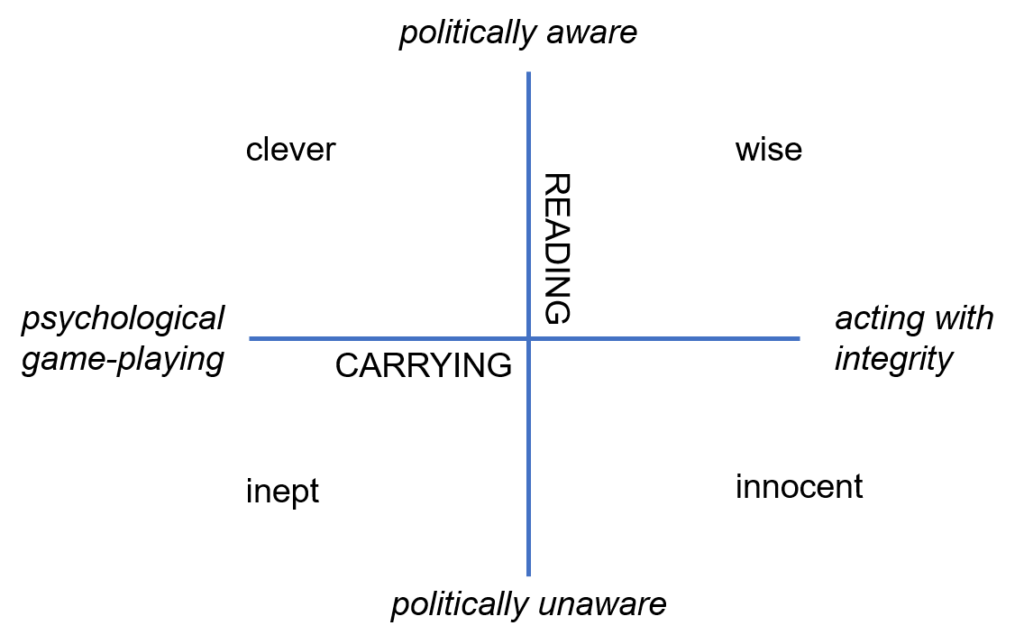
- Innocent – both politically unaware and has integrity. This is typified by blindness to power and other organisational issues and is used by people whose emphasis is on professional and managerial rationality. These people may view political skill as, if not actually contemptible, at least ethically compromising. Innocence involves wide-eyed simplicity and guilelessness.
- Clever – both politically aware and a game player. Clever behaviour is typified by opportunism based on a shrewd understanding of how the system works. People using clever behaviour will set up situations so that their own needs are met by the outcome, which may or may not coincide with what the organisation needs. Cleverness seems to involve wiliness and self-centred behaviour.
- Inept – behaviour involving psychological game-playing and political unawareness. Inept behaviour involves the same inability to read the political dimension as ’innocence’, but rather than having internalised the organisation’s needs, inept behaviour like ’cleverness’ is wholly self-oriented. ’Inept’ plays psychological games in the organisation which confirm all their worst feelings about themselves and others.
- Wise – This involves being politically aware whilst maintaining integrity. Defining characteristics of wise are ’creativity’ and ’imagination’ and an absence of preconceptions about how to handle each situation as it arises.
Developing political leadership skills
The development of skills based on this model include developing their understanding of:
- trends in the way politicians are becoming involved in the management of local authorities
- how authorities have learned to operate when changes in administration to left or right have occurred after many years of one-party dominance, or a new and growing phenomenon, the ’hung’ or ’balanced’ authority
- the skill of analysing power in the organisation, the culture of the organisation and its constituent parts, the procedures which can be used to facilitate or hinder action
- psychological game playing, which needs careful distinction from the tactics of manoeuvring needed for wise behaviour
- ‘out-there’ examples to start, which means recognising what happens in other organisations or how others have a propensity to behave. They are then ready to develop their analysis of their own organisation and their self-awareness.
Implications for strengths-based leadership
Politically skilled leaders have good interpersonal skills, particularly listening skills and are known for their values/ethics. They make sure they are always aware of everyone’s viewpoints and are skilled and open to negotiating and cooperating with other. They know how to build support and a sense of loyalty. These are invaluable skills in leading strengths-based practice which focuses on cooperation, involvement and sharing of power.
More specifically, with regards to specific engagement with councillors, strengths-based practice leaders should:
- seek to build buy-in and ownership in any strengths-based visions, strategies and commissioning plans
- involve councillors early and throughout in activities which aim to develop community assets, create new local provision and develop local resources
- consult councillors on how existing community resources can best be used to support strengths-based care and support services, such as local libraries, community centres and faith organisations
- involve councillors in community engagement and co-production exercises, both as a source of vital community knowledge themselves, and also to help convene others you seek to engage
- seek opportunities to build the understanding and knowledge of councillors in strengths-based practice.
Role of elected members and interaction with them: Catherine Mangan
For more information:
- Owl, Fox, Donkey, or Sheep: Political skills for managers (Baddeley & James, 1987)
- The councillor’s role (LGA)
- A councillor’s workbook on community leadership (LGA, 2017)
- The 21st century councillor (University of Birmingham)