
Leadership of teams
The functioning of teams
Most of our work as professionals is organised through our membership of teams. We will generally have a core team as the organisational unit to which we are attached for the purpose of budgets, communications, management support and human resource functions. In the past it was typical for core teams to be composed of those from the same professional background, but it is increasingly common for such teams to be inter-professional. Alongside our core teams, many of us will also be members of multidisciplinary teams which bring together professionals in relation to the needs of children and/or adults living in the same community or who are facing similar difficulties. These often involve attending regular meetings to share our agency’s knowledge of the situation and to contribute our disciplinary perspectives and resources. Professionals are also members of bespoke teams which are created to work with individuals and families in relation to a particular issue. These teams can be short or long term, dependant on the needs and situation. And finally, many of us will be part of organisational or partnership project teams which review current practices and processes and seek to coordinate the implementation of new approaches.
There has been considerable research in relation to the functioning of teams in the private and public sector (Jelphs et al 2016). This has revealed that when they are run well, teams can lead to better productivity, improvements in quality, and greater wellbeing for their members. Equally, a badly run team is worse than people working in isolation. There is remarkable similarity in the factors that facilitate good team working across different contexts and types of teams (West & Lyubovnikova, 2013). These can be classified as ‘inputs’ and ‘processes’. Team inputs include:
- a clear set of responsibilities which are relevant to the members of the team and which require interaction between team members in order to achieve the related tasks
- the necessary composition of members to ensure that they have the skills, knowledge and values to fulfil their responsibilities
- the necessary support from their organisation and / or partnership.
This support could include relevant capacity, recognition and access to resources. Team processes include: shared objectives which are agreed by team members and which provide sufficient challenge and aspirations; and being reflexive as a team on what is being achieved and how the team’s work can be improved. Such reflexivity requires the team to gather relevant data on progress with their objectives, to ensure that they have regular opportunities to come together, and be willing to constructively critique and challenge each other. Such reflexivity and trust also facilitates opportunities for creative team thinking.
See this film by Professor Michael West on team creativity.
Leading successful teams
Leadership is consistently highlighted as the key enabler of successful teams. In line with general leadership thinking, the focus in the past was on the formal team leader and how their behaviour resulted in better or worse team functioning (Morgeson et al, 2010). Team leaders were seen to have both ‘internal’ and ‘external’ tasks. ‘Internal’ tasks related to the how work was coordinated and processes, and team members were expected to contribute and be accountable. ‘External’ tasks related to the interaction of the team within its wider organisational context and its relationship with other teams.
Recent thinking has recognised that leadership within successful teams is more collective in nature with individual members demonstrating leadership in relation to challenges that reflect their particular skill set and experience (Day et al, 2004). The role of the formal leader is not to complete all of the tasks themselves, but rather to have an overview of how the team functions, to encourage others to demonstrate leadership in relation to appropriate areas, and to ensure that the team takes ownership of difficult issues to find a shared solution.
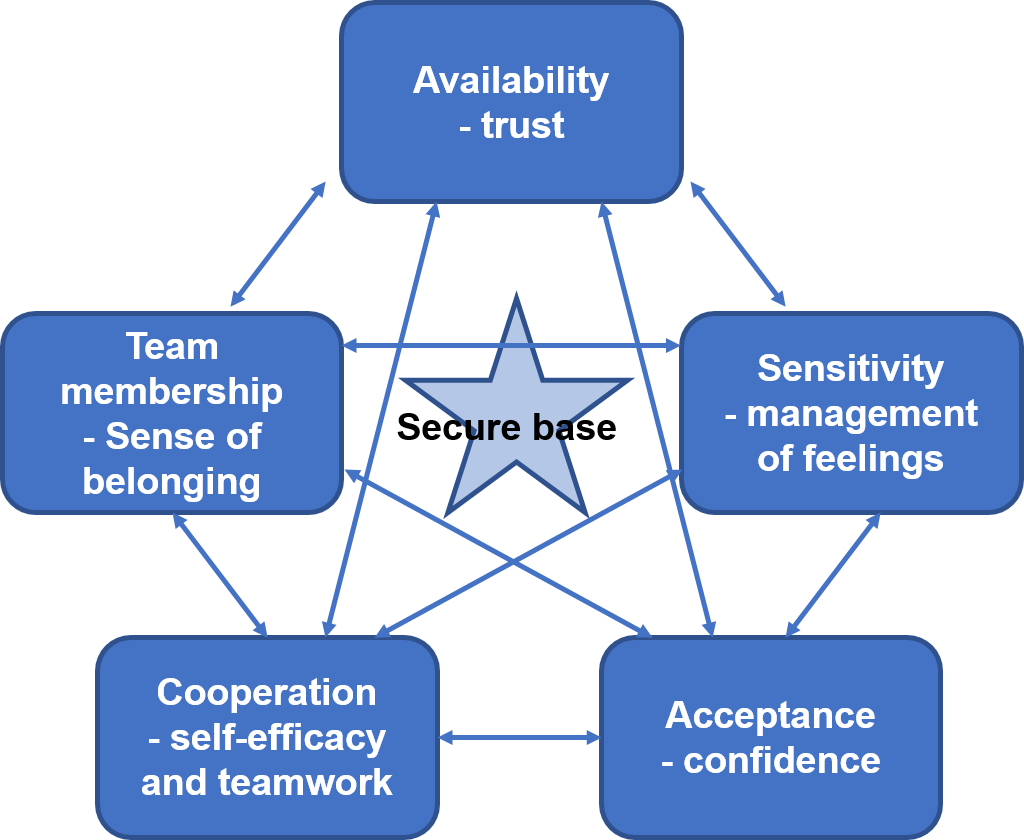
Formal team leaders still have an important role in setting the culture of how team members will support each other in the often distressing situations which professionals can encounter in their work. Biggart et al (2017) describe this as teams providing a ‘secure base’, which they say incorporates five dimensions (Figure 2). Self-managed teams are explicitly designed to provide team members with collective discretion over how they organise tasks and achieve team goals – this may involve an identified team leader but not necessarily (see film by Helen Sanderson regarding self-managed teams).
Figure 2: Secure base model
Multi-disciplinary (MDTs) (or as they should be more accurately called) inter-professional teams are being promoted across health and social care to enable more person and family centred care. They do though have particular complications in relation to their leadership, including:
- the formal team leader not fully understanding the roles and requirements of different professional groups;
- existing hierarchies between professions resulting in some members being dominant in the discussions;
- team members being asked to take on new tasks and unfamiliar processes; and
- a lack of clarity about the boundaries between roles and who is responsible for what decisions (Folkman et al, 2019).
To address these issues, MDTs need to have a clear role and purpose, be well led and organised, have sufficient diversity of professions and disciplines, and be supported by an enabling infrastructure. Such teams must be pro-active in how they engage individuals and families in their discussions and decision making, and connect with other services and teams in their neighbourhoods and place (SCIE 2022).
The Secure Base Model was initially developed to guide foster carers in how to support children and young people to cope with emotional challenges. The model was then explored by Biggart et al (2017) in relation to the emotional experiences of children and family social workers. This included their teams, supervision and the wider organisational environment.
Their findings suggest that the Secure Base Model is applicable to how professionals can be supported to cope with the many emotional demands of their role. Team membership, and the sense of belonging that this can provide, was central to professionals believing that they can trust and rely on their colleagues. A supportive culture within teams was demonstrated through the following aspects:
- Availability – colleagues within the team are physically, emotionally, and practically available to support with emotional needs.
- Sensitivity – colleagues, including practice supervisors and managers, are tuned in to what team members are feeling and thinking.
- Acceptance – team members are provided non-judgemental feedback which builds their self-worth and encourages them to learn from mistakes.
- Cooperation – teams have a culture of collaboration in which more experienced members will support less experienced colleagues to develop their skills and confidence.
Take a look at SCIE’s new resource: Multidisciplinary teams: Integrating care in places and neighbourhoods