

Quality
SCIE’s tried and tested diagnostic approach enables you to identify gaps and challenges as well as what is working well:
- Practice with impact
- Pathway redesign
- CQC post assurance support
This website will offer limited functionality in this browser. We only support the recent versions of major browsers like Chrome, Firefox, Safari, and Edge.
Adult social care faces unprecedented challenges. However, there is also a real opportunity to reimagine social care.
We work in collaboration with local authorities, and the communities you serve, to transform care.
We recognise that local areas have different starting points and we will work closely and flexibly with you to tailor our support appropriately.
SCIE’s tried and tested diagnostic approach enables you to identify gaps and challenges as well as what is working well:

Work with us to identify sustainable models of care:

Access capacity and capabilities to fully embed your transformation and change strategy:
SCIE provides evidence and insights to inform decision-making and to influence, develop and evaluate policy to improve practice and outcomes.
We have launched a new report, ‘Towards a National Care Service: raising national standards of care’, which sets out how national standards could help deliver greater consistency, fairness and quality in adult social care across England. The Government has committed to reform adult social care through creating a National Care Service, underpinned by national standards of care. Beyond this commitment, we know very little about what national standards of care will look like, how they will be delivered or what they are aimed at achieving.
SCIE, with support from The Access Group, has therefore hosted a series of roundtables to help define national standards of care and shape the government’s reforms.
Drawing on evidence from SCIE-led policy roundtables and lived experience, our report proposes a practical framework for translating shared values into clear, outcome-focused expectations for a future National Care Service.
The purpose of the roundtables was to co-produce the practical framework mentioned above that will support consistency, personalisation and quality across the country. These roundtables brought together policymakers, commissioners, people who draw on care and support, unpaid carers, providers and researchers to debate the principles, key opportunities and levers for change.
The following appendices share insights from each roundtable discussion.
Insights from the first SCIE and The Access Group roundtable
20 October 2025
Insights from the second SCIE and The Access Group roundtable
30 October 2025
Insights from the third SCIE and The Access Group roundtable
13 November 2025
Insights from the fourth SCIE and The Access Group roundtable
25 November 2025
This collection of blogs and press releases brings together key insights from a series of cross-sector discussions led by SCIE in partnership with The Access Group. Drawing on perspectives from social care, health, government, regulation and lived experience, it examines accountability, trust and how national standards can genuinely improve people’s lives.
SCIE and The Access Group lead sector drive to define national standards of care
Towards a National Care Service – By Kathryn Marsden OBE, SCIE Chief Executive Officer

Work with SCIE to help identify, spread and scale innovation at local and national levels.

SCIE brings together sector leaders, harnessing the expertise and power of others to test and learn.

We work with Government to find solutions that help them to translate policy into practice – capturing insights.
At a glance 69
Published: January 2015
Last reviewed: December 2020
Signs of abuse can often be difficult to detect. This page aims to help people who come into contact with people with care and support needs to identify abuse and recognise possible indicators. Many forms of abuse are also criminal offences and should be treated that way.
The Care and support statutory guidance identifies ten types of abuse, these are:
Evidence of any one indicator from the following lists should not be taken on its own as proof that abuse is occurring. However, it should alert practitioners to make further assessments and to consider other associated factors. The lists of possible indicators and examples of behaviour are not exhaustive and people may be subject to a number of abuse types at the same time.
Domestic violence or abuse can be characterised by any of the indicators of abuse outlined in this briefing relating to:
See guidance about:
GOV.UK has more information on identifying and reporting modern slavery
Also see: Self-neglect at a glance
We hope this has been helpful. Many aspects of keeping people safe from abuse are complex, and it is important that they are fully understood. SCIE offers e-learning, bespoke training, and consultancy support, to make sure that you and your organisation are aware of good safeguarding practice and your legal duties in this area. Or if you would like to talk to our team about how we can help, please complete our enquiry form.
The Social Care Institute for Excellence is a national charity and improvement agency which improves the lived experience of people using social care.
We do this by working in partnership with people with lived experience, commissioners, organisations which provide care and policy makers but we are independent of any specific sector interest. We influence improved outcomes through a range of activities including consultancy, policy development, research and evaluation, audits and reviews, training and the production of evidence-based tools and resources.
To help us implement our ambitious new strategy we are looking for a number of experienced, adaptable, highly motivated and outcome-focused individuals to join our fantastic team that makes evidence-based improvements for people with lived experience of social care by achieving the following:
First and foremost, we are looking for the right type of individual, someone who is interested in the vision and values of the organisation and who wants to make a difference.
This is a fantastic opportunity to join our small, friendly team and play a pivotal role in improving social care practice across the country.
· Working with frontline health and social care providers across the country to transform care and support.
· Creating an inspiring and engaging learning environment ( in person / virtual)
· Working alongside other staff in service improvement / consultancy projects within SCIE
What we are looking for:
· Knowledge and experience of adult social care practice (preferably in Mental health or Care Act)
· Experience of developing and delivering training courses on a range of topics
· Commitment to equity, diversity, and inclusion
· Confidence in delivering virtually
What we offer in return:
We offer excellent staff benefits including a competitive salary and homeworking allowance. We provide an employer pension contribution above the statutory minimum, an award-winning employee assistance programme, and an attractive holiday package which rises with length of service. Benefits of working for SCIE can be found here Work for the Social Care Institute for Excellence – SCIE
If you would like to access the application form in a different format or if would like any assistance that might help improve your experience while completing the application, please contact us.
Find out more and applyWe are seeking a finance professional, ideally a fully qualified accountant who can help the Board oversee SCIE’s financial health, controls, risk and long-term sustainability. You will combine strategic judgement with constructive challenge and a collaborative, inclusive approach.
The Treasurer is a trustee with a specific leadership role in helping the Board fulfil its collective financial responsibilities and will chair the Audit and Risk Committee. Working with the Chair, Chief Executive and Director of People, Finance and Corporate Resources, the Treasurer provides strategic financial insight, constructive challenge and assurance on SCIE’s financial health, controls, audit, risk and long-term sustainability. The Treasurer does not manage day-to-day finance; accountability for decisions remains with the Board collectively, while operational delivery rests with the executive team.
As a member of the Board, the Treasurer shares responsibility for SCIE’s strategy, governance and stewardship. They will act in SCIE’s best interests, exercise independent judgement, review proposals critically and objectively, and support and challenge the executive team in a constructive, inclusive and proportionate way.
For full details, please see the Treasurer Pack attached.
Contract and salary
How to apply for this role
We would also be grateful if you would complete the Equality and Diversity monitoring form on the online application process.ring form on the online application process.
Recruitment timetable
Closing date: close of business 23 October 2026
Shortlisting: 26 October 2026
Interviews: 30 October 2026
We’re looking for a senior leader to take SCIE further at a pivotal moment for social care — widening our influence, growing new commercial income, and making sure our evidence and our voice are heard wherever decisions about the future of care are being made.
We need someone commercially sharp, fluent in the politics and practicalities of health and social care, and comfortable representing SCIE in rooms that span Whitehall, local government, providers, media and people with direct experience of care. Just as important is how you do it — judgement and presence that earn trust quickly, and the ability to hold together a diverse sector under pressure.
Contract and salary
What we offer in return:
We offer excellent staff benefits including a competitive salary and homeworking allowance. We provide an employer pension contribution above the statutory minimum, an award-winning employee assistance programme, and an attractive holiday package which rises with length of service. Benefits of working for SCIE can be found here Work for the Social Care Institute for Excellence – SCIE
If you would like to access the application form in a different format or if would like any assistance that might help improve your experience while completing the application, please contact us.
How to apply for this role
To make an application, please go to Starfish link and click on the apply now button, with the following prepared:
We would also be grateful if you would complete the Equality and Diversity monitoring form on the online application process.ring form on the online application process.
Apply nowGuideline only. Please check the ‘How to Apply’ instructions for the specific role you are interested in, as you may be required to complete additional tasks unique to that application or use a recruitment portal.
If you want to be part of a great team that is passionate about improving social care, then please apply when there is a vacancy. For your application to be considered, you are likely to need to include the following:
Please send all applications and supporting information to recruitment@scie.org.uk
If you have any questions please contact recruitment@scie.org.uk
No agencies or consultancies – we are looking for experienced individuals.
UK resident applicants ONLY. You must already have the right to work within the UK
You may be asked to take a test as well as attend an interview, which would take place online.
Please make sure that you have enclosed all the relevant documents with your application.
We value diversity in our workforce and are committed to equal opportunities. SCIE is a Disability Confident Employer and offers a guaranteed interview to candidates with disabilities who meet all essential criteria.
Please note, that as a homeworking organisation we require the successful candidate to have a reliable Wi-Fi connection and a minimum 10Mb/s broadband.
In order to stay connected to your colleagues and the work of the wider organisation you will be required to travel to London on a monthly basis to attend meetings. You may also be required to travel to UK-based clients for meetings and events necessary for the role.
Again, please ensure you check the instructions for the role you are applying for as they may vary or require additional tasks.
As an independent charity, the Social Care Institute for Excellence (SCIE) works with organisations across England, Scotland, Wales and Northern Ireland to deliver outstanding and mutually beneficial partnerships that deliver clear benefits. These help make a difference to adults and children with care and support needs and those that care for them across the whole social care sector.
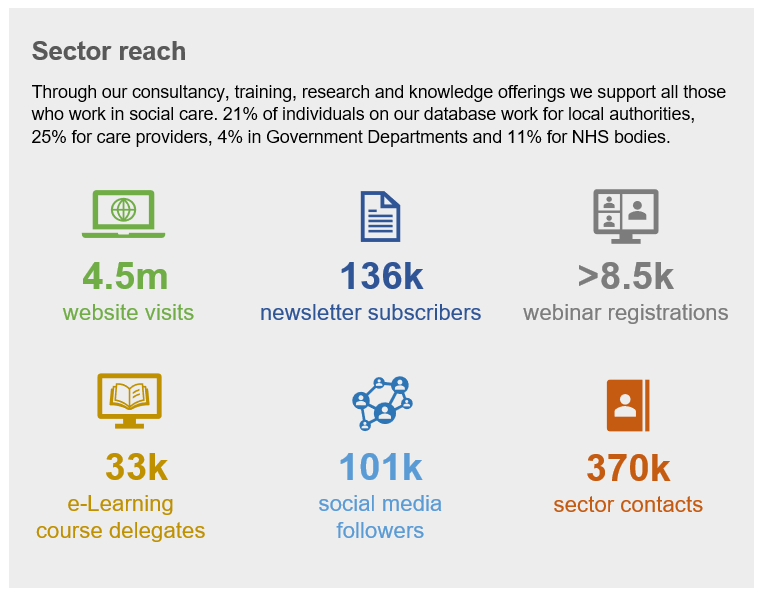
By partnering with us you can help create lasting system change and work with a trusted expert who has extensive reach across the social care sector:
The fund was launched by DHSC in October 2023 and aims to boost the quality and accessibility of adult social care by supporting innovation and scaling, and improving care and support services for unpaid carers. SCIE provides hands-on support to local areas in developing projects for the exciting £42.6 million fund.
See how SCIE is helping to shape the future of adult social care and drive change for unpaid carers through the Accelerating Reform Fund.
Since 2023 SCIE has worked with Care Talk magazine to support their awards programme including the Great British Care Awards, Dementia Care awards and Housing with Care awards. SCIE’s co-production steering group members have acted as judges for the co-production category in each award, selecting worthy winners from across the country. SCIE is proud to work with Care Talk magazine to highlight the great work and best practice in co-production by care providers across the country.
We are proud to be part of EquaDem Network Plus which is a new national five-year Economic and Social Research Council, Alzheimer’s Society, National Institute for Health and Care Research funded network aiming to bring together different stakeholders across England and jointly find solutions to address inequalities in dementia diagnosis and care. The network is hosted by seven Universities working alongside the Lewy Body Society, Dementia UK, Mersey Care NHS Trust, Social Care Institute for Excellence, other social care organisations, and Dementia Researcher.
<a title="Opens in a new window"href=https://www.alzheimers.org.uk/research/researchers/our-funding-schemes/Dementia-Network-Plus
target=”_blank” rel=”noopener”>Learn about our role in this vital network.
This continues to build on our work as a semi-finalist in the Longitude Prize on Dementia.
Find out more.
In April 2025, SCIE proudly launched our first Social Care Impact Awards which we created to identify, recognise and reward small organisations doing exceptional work in social care. We are proud to be supporting the sector by offering free expert consultancy and training to the winning organisations.
We are very grateful for the support of the Rayne Foundation who are match funding an additional first prize for the small organisation category.
Learn more about The Rayne Foundation.
Each of our partnerships is unique. We want to explore the different ways we can work together perhaps through strategic partnerships, donations to projects or event sponsorships.
As a partner you will gain increased exposure, insight and understanding to the social care sector and its’ key audiences, and have unique networking opportunities.
We look forward to working with you. Together we can help improve lives for those who draw on care and support.

This collection of improvement support and resources is designed to help local authorities, health and care providers, safeguarding boards, churches and faith groups to safeguard those at risk.
Information and guidance for care and health staff to support, protect and empower people who may lack capacity.
Find out moreOur guide on dignity in care – providing care that supports the self-respect of the person, recognising their capacities and ambitions, and does nothing to undermine it.
Find out moreThis resource supports social workers and other social care staff to improve recording skills.
Find out moreResources, information and guidance on providing personalised person-centred care for care providers, managers and practitioners.
Find out moreResources to support restarting or continuing activities in community-based day services and day centres (including specialised environments)
Find out moreResources to help local authorities and care providers to analyse, develop, deliver and evaluate Care Act implementation programmes.
Find out moreResources to support care practitioners about assessment and determination of eligibility under the Care Act.
Find out moreResources to help commissioning officers in local authorities think through their duties and understand how to comply with the requirements of the Act.
Find out moreThese resources describe how SBAs work in a variety of interventions and settings and provide information on how to enable and implement SBAs.
Find out moreResources on integrating health, care and related services, including guides, models and evidence.
Find out moreGuidance and advice for housing providers on their role in health and social care including safeguarding, hoarding and integrated care.
Find out moreCo-production resources for health and social care managers commissioners, frontline practitioners, people who use services and carers.
Find out moreHow innovative, small-scale models of health, social care and support could be scaled up to improve support to adults and children.
Find out moreGuidance and practical examples for commissioners to help them support providers in delivering good care provision.
Find out moreSCIE supports the work of Social Care Wales by the continued provision of high quality knowledge about what works and the provision of evidence and research based services to social care leaders in Wales.
Find out moreResources which cover Northern Ireland to inform practice and service developments.
Find out moreBespoke online or face-to-face learning and development including: safeguarding, co-production & strengths-based approaches.
SCIE is a leading provider of CPD-accredited training and consultancy in health and social care. Our courses are developed in collaboration with the sector and delivered by subject matter experts to ensure their relevance, practical application and impact.
Make an enquiry
All of our courses are delivered by subject experts to ensure their relevance and practical application.
View coursesWe offer bespoke training courses which can be delivered to your organisation or team.
View courses
Improve frontline knowledge, skills and practice in health and social care with the latest e-learning courses from SCIE.
View courses
We are your not-for-profit partner, working with you to identify and implement improvements. We offer customised solutions that improve quality, safety, and outcomes in social care.
We have a track record in transforming care and support locally, auditing and improving your Safeguarding culture, digital transformation, and influencing policy and practice.
Get in touch
Our team, comprising former social care practitioners, researchers, and training experts, brings an immense passion and shared commitment to the cause.
To find out how we can support you, complete our enquiry form, or read more about our offers below.
Adult social care faces unprecedented challenges. However, there is also a real opportunity to reimagine social care.
We work in collaboration with local authorities, and the communities you serve, to transform care.
We recognise that local areas have different starting points and we will work closely and flexibly with you to tailor our support appropriately.
SCIE’s diagnostic approach enables you to identify gaps and challenges as well as what is working well:
Work with us to identify sustainable models of care:
Access capacity and capabilities to fully embed your transformation and change strategy:
Learn from safeguarding incidents and assess current practice across both children and adults’ safeguarding.
Understanding your safeguarding duties and responsibilities, and developing and embedding good safeguarding practice, is key for all organisations.
Whether your organisation works with children and young people, adults, or both, we can work with you to make sure that the correct measures are in place to safeguard them from harm or neglect.
We undertake rapid reviews of safeguarding practice. We help you to identify where things are working less well and what the barriers are to overcoming challenges.
Rapid reviewsSCIE’s experts can work with you to audit your safeguarding systems and culture. Our collaborative approach provides a deeper understanding of current local practice.
Safeguarding auditsWork with SCIE to build the capacity and capabilities to implement required changes to your safeguarding governance, processes and culture.
Talk to usDiscover how SCIE worked with Bromley to deliver 2 million in savings, and how we could remodel your digital approaches and capabilities.
Digital change programme
We work with teams across local government, care, health and housing to identify and embed new ways of working and to deliver strategic priorities.
Find out more
Learn from safeguarding incidents and assess current practice across both children and adults’ safeguarding.
Find out more
We work with national partners to develop, embed and assess social care policy, innovation and integration.
Find out moreWe gather and analyse knowledge about what works and translate that knowledge into practical resources, learning materials and services. Our work helps to improve the knowledge and skills of those working in care services. This includes managers, frontline staff, commissioners and trainers. People who use services, and their families, also use our resources.
We also share SCIE’s resources within Northern Ireland to inform practice and service developments. SCIE is undertaking projects to inform developments in social work and social care and we are making sure that a range of SCIE products reflect local legislation and policy context.
Find out more about SCIE‘s work in Northern Ireland.
We support the development of social care in Wales, to improve the knowledge and skills of those working in care services.
Find out more about SCIE‘s work in Wales.
SCIE’s work is of interest to social care researchers and practitioners from around the world. For example, we work closely with the Campbell Collaboration, the international body that maintains standards in systematic reviewing. We also have a number of projects with international partners.
SCIE has provided expert support on conducting significant case reviews, learning reviews and audits to improve child and adult protection practice in Scotland.
We are an independent social care charity working with a wide range of partners and people with lived experience.
We provide innovative consultancy, expert training, extensive resources and information and evidence-based insights for the continual improvement of social care for adults and children.

We seek to:
We collaborate and innovate in social care to improve lives.
A society which enables people who draw on social care to live fulfilling lives.
To support best practice, shape policy and raise awareness of the importance of social care, working together.
The success of our strategy doesn’t just rely on what we do, but how we do it. This is where our values come in. We are committed to becoming a more diverse and inclusive organisation and living up to our values in everything we do.
We are ambitious about building the leadership and culture we need to enable our people to work at their best. We will develop a behavioural framework that ensures we are all living our values and are holding each other to account for continual improvement.
Over the last 20 years we have worked across the social care sector gaining an invaluable insight into the issues that have affected people. We know what works in terms of good social care and support as well as why it works and how engaged and supportive communities can make a difference.
It is no longer sufficient nor appropriate to rely on platitudes or statements of intent when addressing the question of inequality in our society.
The inequalities in health and social care exposed by the COVID-19 crisis and the Black Lives Matter movement have shown us that this is no longer enough. To uphold the right for people to be treated equally, no matter their background, requires more.
SCIE’s role must be to challenge the structural inequalities in our society as it relates to social care.
To do so, it will hold itself to account in recruitment, and how it supports and develops its staff; people who represent the diverse society in which we live. They will be talented and confident in the knowledge that they will be judged by their ability alone.
In addition, SCIE will ensure that the voices of those it represents will always include those most disadvantaged by the structures of discrimination in our society, and hold its partners to account, as well. SCIE believes that co-production, both inclusive and transparent, presents the best opportunity to achieve this.
We have worked with knowledgeable and skilled partners to research and evidence the best examples of good social care and we will now focus our resources around three strategic intentions, where we believe we can achieve the greatest impact.
We recognise that the policy and operating context is different across the four countries of the UK, and different again between children’s and adult social care. We bring perspectives and learning from working with services for people of all ages, families and communities across the life course.
This means we bring insight from different parts of the system, building on the best available evidence and learning from practice and policy in both children’s and adult services. An example of this being when SCIE established the What Works for Children’s Social Care centre and led on stakeholder engagement.
Through our work, research and evidence, from both an academic perspective and from evidence gained through the lived experience of people accessing care and support, we will reflect on the differences in inequalities in social care, as a part of our drive to improve on these areas.
We always seek to ensure that our priorities, how we deploy our expertise, and our ways of working reflects these differences.
In order to deliver our strategy, we have established five key principles which will run across everything we do. These will enable us to continue to grow and strengthen our internal capabilities, and consolidate how we work with partners and people who access care and support. These are:
Embed co-production and the full contribution of people with lived experience in our work, the design and delivery of care and support services and in policy and research to better meet peoples’ needs.
This means we want to place co-production at the heart of research, policy, design and delivery of care and support services.
Co-production is about collaboration and autonomy. It brings people, family members, carers, organisations and commissioners together to share influence, skills and experience. This leads to the design, delivery and monitoring of services and projects where people are treated as equals. In this way, co-production is a powerful tool in addressing inequality, as it ensures equality, diversity and inclusion.
The voice, insights and experience of people with lived experience should be embedded within research, policy, and the design and delivery of care and support services. SCIE is committed to developing understanding, increasing confidence and encouraging the application of co-production internally and across the entire social care sector.
More co-production through collaboration between commissioners and people delivering care and support, and those with lived experience of accessing those services.
Year 1: We will co-produce (with SCIE’s Co-production Steering Group) a vision and strategy for co-production in SCIE and a co-production evaluation tool.
Year 2: By implementing our co-production strategy, we will start to deliver our vision for co-production.
Year 3: We will develop and deliver our offer to support the wider sector in adopting co-production.
SCIE will use the % of SCIE staff across all teams who are confident in defining co-production and underpinning principles as a key metric.
SCIE will undertake benchmarking and annual evaluation of the experiences of staff and people drawing on care and support in relation to how well SCIE is working in coproduction and seek to demonstrate year on year progress.
Drive innovation and improvement in social care to deliver better outcomes for children and adults who need care and support.
This means we will champion new and better ways of providing care and support.
Care and support needs to be person-centred, preventative and strengths-based. Delivering this, particularly in the face of increasing demand for services, limited budgets, workforce challenges and widening health inequalities demands working in new and better ways. A key driver for innovation and improvement is SCIE’s commitment to addressing systematic inequalities and promoting equality, diversity, and inclusion.
SCIE is committed to supporting the delivery of outcomes for children and adults who need care and support. We will do this by increasing the confidence of people delivering social care and commissioners to identify and adopt the most effective approaches.
Leaders in health and care working jointly and confidently to ensure best practices in care and support are adopted by commissioners and providers of services.
Year 1: We will build our capacity and capability and develop new support offers in innovation, integration and children’s services which keep the person accessing care at their heart.
Year 2: Our new offer, embodying a person-centred approach, will be tested and implemented.
Year 3: We will seek out opportunities to be a partner in national programmes to spearhead improvement and innovation.
SCIE will use the % of respondents that advise us they have changed their practice or approach as a result of the service improvement support we provide as a key metric.
Influence and support implementation and delivery of better policy to improve the lives of people accessing care and support.
This means we will contribute to better policy which achieves true integration and improves lives.
For people accessing health and social care support, meaningful integration which extends across not only health and care services but also into housing and education could transform their lives.
SCIE is committed to conducting the research, providing the evidence and influencing policy to make this integration a reality.
What we want to achieve
A direct link between SCIE’s research evidence and more effective and compassionate social care policy emerging.
Year 1: We will develop a plan to influence national governments and secure better social care policy which is evidence-based, reflects best practice and improves lives.
Year 2: This influencing plan will be rolled out – ensuring the expertise and voice of SCIE is central in the national conversation about social care reform.
Year 3: We will deliver projects based on our innovation and improvement research.
SCIE will track the reference or use of our research and policy recommendations in government programmes or plans as a key metric.
Improve safeguarding skills, knowledge and practice to keep children and adults safe and support their social wellbeing.
This means we will drive improvement in safeguarding to protect adults, children, and their social wellbeing.
Safeguarding means protecting children and adults from harm, abuse, and neglect. It is essential in all environments, vital in ensuring people feel safe and important for social wellbeing.
SCIE is committed to ensuring effective safeguarding processes are in place across all settings.
Effective safeguarding processes across all settings.
Year 1: We will review current safeguarding approaches and begin developing new tools and programmes for safeguarding audits and compliance in particular environments.
Year 2: Selected new person-centred tools and programmes will be tested and implemented in different settings. We will evaluate which approaches could be transferrable to other sectors.
Year 3: We will seek out opportunities to be the safeguarding partner for national programmes to spearhead improved safeguarding.
SCIE will use the % of respondents that advise us they have changed their safeguarding practice or approach as a result of the support we provide as a key metric.
To ensure our strategy was fit for purpose, inclusive and comprehensive, SCIE undertook a period of detailed research. This included interviewing experts and analysing the context in which SCIE operates – politically, economically, socially and technologically.
This research informed the development of initial strategic objectives. We then shaped these through workshops and testing with SCIE staff, the Board of Trustees (including a dedicated Task and Finish Group) and SCIE’s Co-production Steering Group of people with lived experience of social care.
Implementation planning then determined how we would bring each finalised objective to life through key projects and activities.
SCIE’s vision is:
“A society where care and support maximises people’s choices, removes social inequality and enables people to live fulfilling, safe and healthy lives.”
It is a mission to reform society, and therefore a strategy to pursue it must be developed in response to the challenges of today and tomorrow. To be effective, it must be constructed to meet demands presented by political, economic, social and technological factors. To be actionable, it must acknowledge relevant elements of internal and external context.
This strategy has been developed with consideration of relevant challenges and opportunities, including:
SCIE has identified that collaboration will be vital to successfully delivering its four strategic objectives. SCIE will:
A member of the Senior Leadership Team (SLT) has been identified as a lead for each activity SCIE will undertake in pursuing these objectives. The SLT and Operational Leadership Team will monitor SCIE’s progress in achieving these objectives quarterly. To do this, they will use the key metrics identified to evaluate the impact of each objective. They will report this progress to the Board on a quarterly basis. The implementation plan for each objective will be reassessed annually. The SLT will also assess risks to the delivery of this strategy and ensure they are appropriately reported and managed.
We are an independent social care charity working with a wide range of partners and people with lived experience, to improve people’s lives.
SCIE provides world-class extensive resources, information and evidence-based insights, innovative consultancy, and expert training for the continual improvement of social care. We work with national government including the Department of Health and Social Care (DHSC), local authorities, care providers, academics and charitable foundations. Read our impact report.
Using our trusted evidence and wealth of experience, we want to help create a fair and equal society, where care maximises people’s choices and removes social inequality.
If you would like to collaborate or partner with us, or support our charitable activities or events, please get in touch:
Your small organisation could gain free support. We will accept submissions again in 2026.
Social Care Impact AwardsWe greatly appreciate individual donations to support our charitable activities. You can donate via our JustGiving page.
Just givingSCIE annual report 2024/25
Our purpose at SCIE is to collaborate and innovate with a whole range of partners so that people can easily receive social care, and through it, live more independent, fulfilling and better lives.
That is why we exist. But we couldn’t do it without you, our partners, and our amazing staff. Our achievements in the last year are joint achievements, and are down to the collaborative and innovative efforts that I see everywhere in social care, despite the hardship and the continuing pressures that so many of you working in social care face on a daily basis. I am proud that SCIE can help to shine a positive light on all the good work you do.
This has been a year of change, bringing fresh promise with the new Government’s talk of a National Care Service. As the Casey Commission moves forward in its efforts to design a better system for the future, we look forward to working with Baroness Casey and partners across the sector – crucially including people receiving care and support, and their family carers – to create sustainable solutions that will truly improve lives.
Across our not-for-profit consultancy, insights, training and resources outputs this year, I have never more strongly seen the power of collaboration and innovation. Perhaps particularly so in our work supporting the Department of Health and Social Care (DHSC)’s Accelerating Reform Fund (ARF). When I visited Worcestershire to understand their project better, the programme leads Kim Terry and Mel Smith were clearly passionate about what they were going to be able to achieve for unpaid carers. I spoke to carers who told me how this work was significantly transforming what had been a very difficult experience for them, helping them to feel supported and connected. The commitment and enthusiasm of staff members shone through as they showed me how innovations like assistive technology were improving lives.
We have now completed our main support role to the ARF, although we are continuing in a small way to help where we can. This was a first of its kind grant fund in England in its focus on identifying and scaling up innovations particularly for unpaid carers, whose enormous selfless contribution does much to keep the system going. Do read our independent report ‘Embracing change: scaling innovation in social care practice’, setting out invaluable key learnings for the sector and best practice so far. We hope it offers you solutions and powerful insights into how to start, sustain and scale innovation. We look forward to reporting back further on progress from this rare, interesting testbed of innovation in practice.
We have had a successful first year working with Partners in Care and Health (PCH) on a programme of sector-led improvement support for social care and public health services in councils, funded by the DHSC. Local authorities and practitioners tell us our direct support, and range of resources supplementing it, are helping them deliver improved services in areas such as digital transformation, housing, safeguarding and co-production. We’re also supporting local authorities requiring improvement post-Care Quality Commission (CQC inspection. I would like to thank all our partners, stakeholders, and supporters, along with my wonderful team at SCIE: every employee, the Board of Trustees, our Co-production Steering Group and wider network who collectively have delivered another successful year of impact to improve lives. It is only together that we can ensure everyone receives high quality care that enables choice, control and independence.
Kathryn Smith, Chief Executive, SCIE

Nine years of purpose, challenge, and reform
When I took on the role of Chair at the Social Care Institute for Excellence (SCIE) in July 2017, I joined an organisation with a distinguished legacy and a deep sense of mission. What I couldn’t have fully appreciated then was just how much this journey would come to define my own commitment to social care reform – and how profoundly the values of co-production, evidence and partnership would shape both the direction of SCIE and the wider reform narrative.
SCIE’s story over the past nine years is one of hard-won transformation – internally, as we restructured and reimagined the organisation for resilience and impact, and externally, as we played an increasingly vital role in responding to crises, shaping policy and catalysing long-overdue change in adult social care. When I arrived, SCIE faced financial fragility. Deficits were ongoing, and though austerity-era funding cuts contributed to the cause, the real challenge ran deeper. The business model had become unsustainable, our operating systems outdated and our organisational footprint misaligned with our income. We needed to change fundamentally to survive – let alone thrive.
Together with our exceptional Board and staff – and most crucially, in partnership with Kathryn Marsden (then Smith), whom I had the privilege of appointing as Chief Executive – we delivered that change. Kathryn brought strategic discipline, clarity of vision, and an unwavering commitment to our values. Her leadership through periods of uncertainty, including the COVID-19 pandemic, was exceptional. We transitioned SCIE into a remote-first organisation, modernised IT and finance systems, exited costly long-term liabilities such as the defined-benefit pension scheme, and diversified income streams. These changes were not easy. They required tough decisions and deep candour. But they worked. We moved from deficits to four consecutive surpluses and counting, built a meaningful reserve, and made strategic investments to create an organisation that is both financially resilient and fit for the future. These internal reforms matter not just for their own sake, but because they have strengthened SCIE’s role as part of the sector’s critical infrastructure – trusted to translate policy into practice, to convene diverse voices, and to deliver meaningful change.
Throughout my tenure, SCIE has remained close to the pulse of the sector. During the pandemic, we launched the National COVID Hub in record time, providing timely guidance and safeguarding resources accessed by hundreds of thousands. We supported local authorities and providers in adapting to fast[1]changing demands, showing SCIE at its agile best – anchored in purpose, driven by need.
But SCIE’s role has extended far beyond crisis response. We have consistently influenced national policy – co-chairing the Commission on the Role of Housing in the Future of Care and Support, embedding Think Local Act Personal (TLAP)’s ‘Making it Real’ framework in CQC’s new assurance model, contributing to the Adult Social Care White Paper, and shaping innovation through the ARF and sector-led improvement programmes. Among these, I am particularly proud of SCIE’s work in 2024/25 supporting the DHSC’s ARF. By helping local systems innovate for unpaid carers, SCIE demonstrated how lived experience and local insight can drive practical solutions with national relevance. This work exemplified the best of SCIE – strategic, people-centred, and grounded in the urgent realities of the system.
SCIE has actively contributed to key system reviews and reform agendas – most recently through our work to support the Casey Commission. These interventions are not merely consultative; they are part of how we embed reform. From parliamentary scrutiny to national design efforts, SCIE has become a bridge between people’s experience and policy ambition. SCIE Annual Report 2025 | 4 The thread that runs through it all is the unfinished business of the Care Act 2014 – a law I had the privilege of helping shape as Care Services Minister. That legislation was a watershed moment: it consolidated decades of fragmented policy, placed wellbeing at the heart of care, strengthened rights for carers and promised a lifetime cap on care costs. It was, and remains, the most coherent blueprint for modern social care this country has produced.
But the promise of the Care Act has too often been betrayed by a lack of delivery. The cap, initially due in 2016, was deferred repeatedly before being finally abandoned in 2024. Local authorities, under increasing financial strain, continue to ration services. Millions of older people and working-age disabled adults remain unsupported. And unpaid carers – around 1.5 million providing more than 50 hours of care a week – shoulder a burden valued at £184 billion annually, often at enormous personal cost.
This is not just a policy failure. It is a moral failure – a systemic reluctance to match legislative vision with political resolve and investment. SCIE’s internal renewal over these nine years has therefore never been just about financial turnaround or operational efficiency. It has been about ensuring that our organisation was ready to meet this national moment with clarity, credibility, and impact.
That moment may now be upon us. The launch of the Casey Commission in early 2025 represents the most promising opportunity in over a decade to restart reform. With interim proposals expected in 2026 and a full vision by 2028 – including the potential creation of a National Care Service underpinned by national care standards – this is a critical juncture. The Commission has rightly warned that failure is possible without a compelling, costed, data-driven case for reform. SCIE continues to argue that reform must not begin from scratch. The Care Act provides the foundation. What’s needed now is implementation: embedding co[1]production as a form of governance, prioritising prevention investment, defining national care standards and creating enduring political consensus. We must move from aspiration to delivery—from legislation to lived experience.
As I prepare to hand over the baton, I do so with full confidence in SCIE’s future. The organisation is financially sound, strategically focused and equipped with an exceptional leadership team. It is ready not only to continue delivering impact today, but to help shape the system we will need for the decade to come: one built on equity, national consistency and meaningful accountability. The next Chair will inherit an organisation well placed to support the implementation of national standards, the evolution of assurance models and the delivery of long-term reform. Our direction is now firmly future-facing – strengthening the infrastructure of care with the same determination that once rescued it from fragility.
I want to thank everyone who has shared this journey: staff, trustees, partners and above all, the people and communities we exist to serve. SCIE has been my professional home for nearly a decade, but it has also been something more: a place where values meet action, and where reform is not just advocated, but actively built. I hope the legacy we leave is clear: an organisation that lives the values it champions, that has helped steer the sector through storm and change and that now stands ready to support the transformation our country so urgently needs. It has been an honour to serve.
Rt Hon Paul Burstow, Chair, SCIE


