

Care Act: Video introduction
SCIE’s introduction to the Care Act video gives an overview of the key aspects of the Act, including personalisation, strengths-based approaches, advocacy, safeguarding, eligibility and more.
Watch the videoThis website will offer limited functionality in this browser. We only support the recent versions of major browsers like Chrome, Firefox, Safari, and Edge.
If you are looking for invoice please visit the My order page or submit an enquiry.
If you are looking for a certificate for a completed course, click into the course, then if the course is completed, there will be a download button.
Resources, training and consultancy to help local authorities and care providers to analyse, develop, deliver and evaluate Care Act implementation programmes.
Updated March 2024
SCIE’s introduction to the Care Act video gives an overview of the key aspects of the Act, including personalisation, strengths-based approaches, advocacy, safeguarding, eligibility and more.
Watch the video
This Care Act training includes bite-sized videos identifying the social care practitioner legal duties and the impact of the legal duties on people in the community.
Watch the videos
We offer a range of CPD-accredited training and learning development programmes in line with the Care Act 2014. Our tailored courses are ideal for anyone working within an organisation providing care and support.
View our coursesA set of factsheets summarising the legal duties for social care practitioners when undertaking and recording assessments of need.
SCIE improves the lives of people of all ages by co-producing, sharing, and supporting the use of the best available knowledge and evidence about what works in practice.
The Social Care Institute for Excellence (SCIE) is an independent social care charity with deep experience of bringing partners and people with lived experience together to collaborate and innovate to improve people’s lives (e.g. national government, DHSC, local authorities, care providers, academics, foundations).
Working across social care, health and related services such as housing, for adults, children and families, we contribute to the development and implementation of better care, support and safeguarding at local and national level.
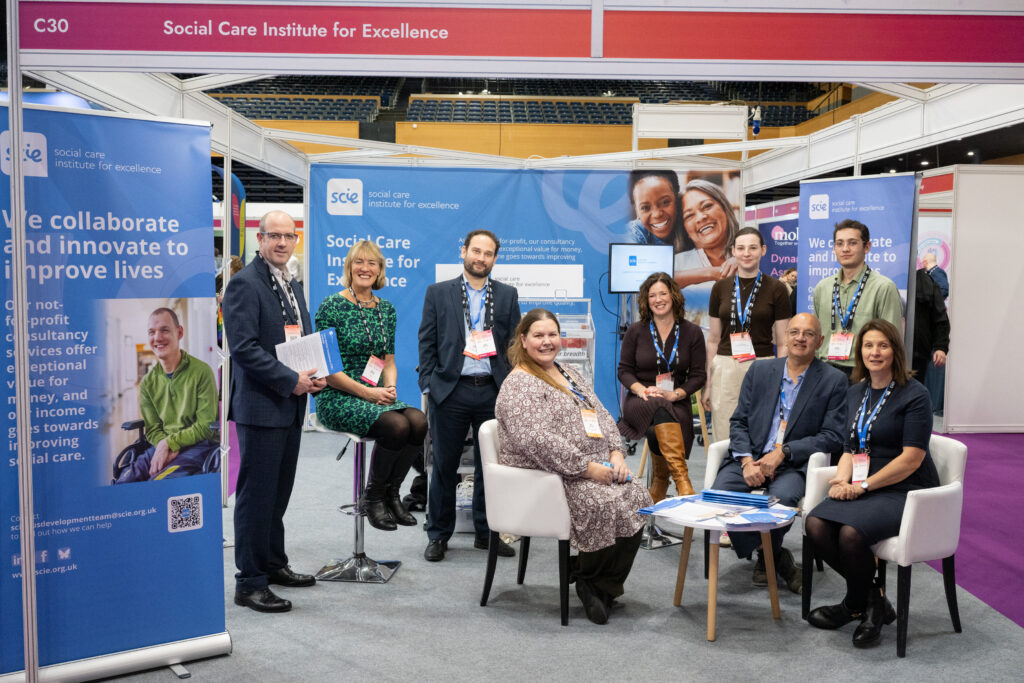
As we are not-for-profit, our income goes towards improving social care. We deliver four main offers, across all of which we support the DHSC annually:
Co-production with people with lived experience of social care underpins and informs what we do, and with over 20 years’ experience we bring a wealth of trusted, evidence-based expertise to work together to help transform care. Our staff – former practitioners in social care, researchers, experts in training – bring immense depth of experience and passion for the cause, based on frontline work, using the best available knowledge about what works in practice.
We believe that the five factors below, in combination, make us a unique and essential improvement partner for the Department of Health and Social Care, and our range of customers across sectors and at national and local levels.
We:
Read our 2024/25 annual report and access reports from previous years.
Summary and reportRead our 2025/26 impact report and access reports from previous years.
Summary and reportSCIE has around 50 staff made up of practice development managers, information specialists, researchers, digital, communications and administrative staff. To contact our staff, please email info@scie.org.uk.
View information about our Board Members.
Gerard joined SCIE in 2020, and most recently held the position of Director of Transformation and Improvement, overseeing SCIE’s innovative consultancy support and expert training. He has led multi-million-pound work programmes supporting local authorities and Government Departments, from social care improvement and transformation, including advising on local authority readiness for social care reform, to safeguarding approaches, workforce development and co-production, delivering millions of cost savings to local authorities to improve lives for adults and children.
Gerard has over 25 years of experience working in the statutory and charity sector, and over 20 years in health and social care, including roles as Director of Quality and Evidence at Healthwatch England/ Care Quality Commission, and Director of Strategy, Impact and Transformation at Independent Age, where he led the organisational response to Covid-19, including gaining the experience of setting up a new multimillion pound fund to support local organisations working with older people.
He has been a member of a number of advisory boards, including the Health and Care Publications Advisory Board, and was recently a member of the CHKS Accreditation Council, advising on the development and publication of accredited quality standards for health and care organisations.

Chris joined SCIE in early 2023 and leads SCIE’s income generation strategies. He has significant experience supporting charities to grow and develop in commissioning, funder and delivery organisations.
Previously he was Director of Business Development at the Healthcare Quality Improvement Partnership, and before that Director of Development at the Social Investment Business.
He started his career in the civil service and has worked across strategy and policy development roles in the Cabinet Office and at Ofsted. Chris was educated at Cambridge University (BA, English Literature) and at the University of London (MA, Latin American Studies).

Aside from a stint working for the web team of a national newspaper, Ian career has been spent exclusively working in disability-related roles. Early experiences with his nan, and as a support worker, led him to question why care and support couldn’t be better at focussing on what really mattered to each person.
Ian joined Alzheimer’s’ Society in 2006, to manage service teams across three counties. Since 2012, his focus has been purely on developing personalisation policy and practice.
Ian believes that the most effective route to meaningful change and workable solutions is through co-production and collaborative partnerships, of which TLAP (Think Local Act Personal) is a pioneering example.

Deborah leads a team supporting improvements in social care through evidence generation, knowledge translation and policy influencing. Her experience includes conducting research studies and leading complex change programmes for government and the NHS, including recent initiatives in integrated care.
Deborah worked previously at the Office for Public Management, the Health Foundation and the Royal College of Nursing.
Earlier in her career, she worked for the Medicare and Medicaid healthcare programmes in the USA. Deborah was educated at Harvard University (AB, History) and UCLA (MSc, Public Health) and is currently studying for an MSc at Imperial College London (Healthcare and Design).

Jon joined SCIE in August 2021 and leads the organisation’s Finance and Corporate Resources functions, which includes information technology.
Jon previously spent 18 years at the University of Kent working in a variety of finance roles, which included managing a research finance team; he was also Business and Facilities Manager at Kent Law School and, more recently, Finance and Resources Manager for the Division of Law, Society and Social Justice.
Outside of SCIE, Jon is a trustee and Treasurer for a local charity, the Canterbury Housing Advice Centre, which seeks to relieve poverty and homelessness in the Canterbury District and primarily focusses on preventing homelessness.
Carolyn started at SCIE as Head of People & Culture in May 2022. Prior to this she was on loan to SCIE from Alzheimer’s Society where she has held a number of roles including heading up HR Business Partnering and organisation-wide people and organisational development projects. Carolyn has worked in both the public and private sector in both operational and HR roles. She’s CIPD (Chartered Institute for Personnel and Development) qualified with over 20 years’ generalist HR experience.
Carolyn lives in Greater Manchester and enjoys spending time with family and friends, as well as foreign travel. Carolyn is passionate about developing a workplace where people are supported to bring their best self to work and fulfil their true potential.
SCIE is governed by a board of trustees who guide its work and ensure its independence.
You can also learn about our Senior Leadership Team.
Baroness Glenys Thornton joined SCIE’s Board as Chair in July 2026. She brings extensive experience of leadership across social care, health, private sector, public service and civil society.
A member of the House of Lords for over 25 years, Glenys has held senior roles in Government, including as a Parliamentary Under Secretary of State for Health, and Minister for Women and Equalities. She was Shadow Health Minister 2010-2014 and again 2018 – 2024.
Other posts include the General Secretary of the Fabian Society, Trustee of Action for Children, Jamie Oliver’s 15 Foundation and Training for Life. She was a board member of the IdEA, the Local Government Improvement agency, from 1999 – 2008 and Chief Executive of The Young Foundation, the UK’s home for community research and social innovation, from 2015 – 2017.
Glenys is currently a Senior Non-Exec Director of Whittington Health, Maternity Lead, a fellow of Social Innovation at the Cambridge Centre for Social Innovation, Judge Business School, University of Cambridge, and founding Chair and Patron of Social Enterprise UK.

Rachel has worked in the health information and media sector for over 25 years, producing evidence-based products and services for doctors, nurses and patients.
As Director of the BMJ Evidence Centre, Rachel gained extensive experience of structuring knowledge and evidence for practitioners and service users to improve best practice and the experience of care.
She then joined the global publisher Elsevier as Director of e-Education Solutions for EMEA/LA. Here she developed and commercialised new, digital learning products for the undergraduate market.
Rachel is currently Managing Director of RCNi, the independent, commercial media arm of the Royal College of Nursing. She is a member of the RCNi Board, Audit and Remuneration Committees, and is responsible for the digital transformation of services to meet the needs of the nursing community.

Dean Okereke is a healthcare transformation leader with over a decade’s experience spanning the NHS, central government and healthcare consulting. He is an experienced strategy consultant who leads on digital transformation and AI adoption for NHS and social care organisations.
Dean previously served at the Department of Health and Social Care as Head of Digital, Data and AI Assurance, overseeing assurance of the National and Frontline Digital Portfolio. His earlier career includes senior roles within NHS provider organisations, Oracle Cerner, and independent electronic patient record (EPR) consulting, giving him a rounded view of digital change from the frontline, the supplier side and the centre of government.
Dean is passionate about addressing inequalities in health and social care, and about using digital and technology solutions to tackle the sector’s most persistent challenges, a thread that has run through much of his career. He brings this experience in governance, assurance and technology-led change to his role as a SCIE Trustee.

Sudha joined SCIE’s Board of Trustees in 2026, bringing over 20 years’ experience across investment management, private credit and impact investing, including over a decade focused on global impact investing.
Sudha is the Founder of Impact Cap, an advisory firm supporting impact-led asset managers through fundraising and investor engagement. She previously spent a number of years as Co-Chief Executive Officer of an emerging-markets-focused investment manager, where she also led on fundraising, marketing, and investor relations, raising over $200m from institutional and private investors.
Sudha is currently Chair of the Investment Committee of a large Foundation focused on energy transition and community regeneration in the UK, and is Chair of Women in Social Finance, a peer-to-peer networking group for senior women shaping financial systems toward more equitable and sustainable outcomes. She holds an MBA with Distinction from the Open University Business School.

Zoë is a commercial procurement specialist currently working in the healthcare sector where she supports the provision of genomic screening services into the NHS.
Zoë is a lifetime disability advocate, having taken up campaigning at the age of 16 with Muscular Dystrophy UK, and having subsequently been a spokesperson and representative for a number of disability-led organisations.
Most recently she was a Trustee at Attitude is Everything, a charity broadening access to live events for disabled people. She is a personal budget user herself and is passionate about the inclusion of younger people in conversations about disability and social care.
Zoë holds an Advanced Diploma in Procurement and Supply and a BA in Politics, Philosophy and Economics from the University of Oxford.

Margaret joined the Board in March 2019. She worked in the NHS for number years where her responsibilities included developing services for people with learning disabilities and managing a range of community health services.
Margaret left the NHS to become Deputy Chief Executive of the Refugee Council. She then went onto the British Red Cross where she was responsible for developing services in the UK including its health and social care offer.
Margaret has previously worked with SCIE including chairing the Group which established Guidelines for the Care and Support of People with Learning Disabilities as They Grow Older.
Margaret is currently trustee of Heritage Care which provides services for older people, people with learning disabilities and people with mental health issues.

Adele Leighton has worked in the charity sector for over 25 years and is currently Director of Operations at Autism Initiatives. She has extensive experience leading regulated health and social care services, with responsibility for strategic leadership, governance, quality, financial sustainability and workforce development.
Prior to joining Autism Initiatives, Adele held senior roles with both Mencap and Alzheimer’s Society. At Alzheimer’s Society she led the organisation’s involvement function, embedding involvement across the charity and ensuring that people with lived experience helped shape services, campaigns, research and organisational priorities.
She is passionate about improving the lives of people who draw on care and support services and believes in the importance of co-production, evidence-informed practice and strong governance. Adele has particular expertise in designing and leading services in dementia, autism and learning disabilities, organisational improvement and leading change within complex, regulated environments.
As a Trustee of SCIE, Adele is committed to supporting the organisation’s mission to improve social care through collaboration, innovation and sharing best practice across the sector.

Brett joined SCIE in July 2022 and is the director of people at the Children’s charity, The National Society for the Prevention of Cruelty to Children (NSPCC).
He has more than 20 years’ experience in the charity sector and specialises in organisational development, including large scale transformational change, leadership development and employee and volunteer engagement.
Brett has held numerous roles at Alzheimer’s Society. He has also worked at Breakthrough Breast Cancer, Cancer Research UK and Amnesty International.
Brett believes passionately in the power of people and in creating working and volunteering environments where everyone feels valued; and where they can be their one true, authentic self.

Welcome to the research, evidence, and policy insights that influence national policy and practice, and drive improvements and innovation in social care.
Talk to us about our Insights
Improving outcomes for people who draw on care and support depends on strong evidence and a clear understanding of what works. SCIE’s trusted insights, research and evidence together underpin our expertise and advice, and directly influence government policy and practice.
SCIE produces applied research for policy and practice that is relevant, timely and grounded in day-to-day experiences of care and support, drawing on lived experience. This ensures that evidence can be translated into practical improvements across the system. SCIE works with partners to co-produce insights, combining research evidence with lived experience and frontline expertise. This strengthens the relevance, credibility and impact of the insights we generate.
SCIE’s presents evidence and insights that influence, develop and evaluate policy.
Our reports and articlesSCIE leads and draws on data analysis, evidence reviews and policy analysis to generate insights that support decision-making and improvement. We help organisations to use evidence more effectively to shape practice and outcomes.
In a changing policy landscape, SCIE provides independent, evidence-based insights to help systems respond to emerging priorities. We connect knowledge, experience and practice to support meaningful and sustained improvement.
SCIE develops and curates accessible data and evidence resources, including hubs and tailored toolkits, to support forward-looking approaches to policy and practice.
This ensures that high-quality insight is easy to find, understand and apply in practice.
SCIE brings together insights from across health and social care to identify patterns, gaps and opportunities for improvement, including social care policy reforms. This whole-system perspective helps policymakers and organisations respond to complexity with greater clarity and confidence.
Through blogs, reports and thought leadership, SCIE brings emerging evidence and insights into wider conversation with partners in the social care sector. We use events to explore emerging issues and innovations, helping the sector to anticipate change and respond proactively.
SCIE delivers programme and impact evaluation, including in areas such as care technology, to build understanding of what works and why. This supports learning, accountability and the effective spread of innovation across the adult social care sector.
As a system focused charity we want to use the skills and resources we have to fulfil our charitable vision of a society which enables people who draw on social care to live fulfilling lives.
If you are interested in helping to fund any of our charitable activities which are featured below, do please get in touch or click on the donate button below. Help create lasting system change and work with trusted experts who have extensive reach across the social care sector.
Thank you for your interest and support.
SCIE aims to embed co-production and the voice of people with lived experience in the design and delivery of care and support services and in policy and research to better meet people’s needs.
In order to fulfil this, we need to ensure that we build our knowledge base about what works in social care with the support and partnership of those that use social care. This ensures that any work we undertake works on a practical as well as a strategic level.
Our Co-production Steering Group advises SCIE on the development of the co-production strategy ensuring all SCIE’s work is informed by the voice of lived experience. They ensure, as an organisation, that we live up to our name in terms of excellence in all that we do.
In line with SCIE’s values we recognise the skill and time of the people we work with and want to continue to be able to pay them for their input in the same way a staff member would be paid.
Each year SCIE covers these costs as an important element of our charitable offer. This equates to approximately £600 per week which provides real value as it is integral to all of our work.
“I want to be fully involved as soon as the idea blossoms. Asking me for my opinion once the idea is set means that I can’t influence the agenda.”
Member of SCIE’s Co-production Steering Group
In the summer of 2023 SCIE, Anthropos and the Dementia Services Development Centre (DSDC) at the University of Stirling were successful in their joint application for funding from the prestigious Longitude Prize on dementia which is funded by Alzheimer’s Society and Innovate UK and delivered by Challenge Works.
The funding will enable our partnership to develop technology that learns about the lives of people with early-mid stage dementia and can detect environmental and behavioural changes associated with periods of distress, anxiety and disorientation, particularly in the evening and nighttime.
These insights could then be used to suggest a helpful intervention for the family or care provider to help reduce that distress to support people living with dementia, remain independent in their homes.
Our exciting project is one of 24 semi-finalist Discovery Award Winners that received seed funding grants as part of the overall £4m Longitude Prize on Dementia driving the co-creation of personalised technologies to help people living with dementia enjoy independent and fulfilled lives.
More information about the Longitude Prize can be found here.
The Commission on the Role of Housing in the Future of Care and Support, funded by the Dunhill Medical Trust and led by SCIE was established in November 2020. The Commission set out a vision and roadmap for providing more options for housing with care and support. It is a 10-year plan to support the health and social care sector to understand how housing with care and support could be planned, commissioned, designed and delivered.
The purpose of this project was to address the inequalities that contributed to people with learning disabilities being six times more likely to die from COVID-19.
New guidance has now been published and we want to thank the various charitable trusts and foundations that have kindly made this project possible. This includes the National Lottery Community Fund and the Santa Barbara Heights Charitable Trust and others who wish to remain anonymous.
In 2023 SCIE established a strategic investment fund for the purpose of generating innovative, standalone activity focused on driving high impact in line with our strategic and charitable objectives.
This has led to the development of SCIE’s first Social Care Impact Awards for small and micro social care organisations. This investment means we are reaching segments of the care sector who would not ordinarily be able to access our consultancy, insights, training and resources support.
“Winning this award means we can move forward with our mission of reaching as many people within our community as possible. Our goal is to widen our horizons and be able to bring our unique offerings to those in need in surrounding areas. The consultancy and training we will receive for winning this wonderful award will give us the springboard to do just that and continue “Empowering Every Ability’.” Team2Gether Suffolk, one of our awards winners.
Ultimately, our aim is to improve the lives of those who draw on care and support and we will be providing updates on the progress of the new award winners and the impact of our support in due course.
This year, we have received pro-bono support from a corporate partner in the design and development of the awards and also received match funding to widen the prize pool by the Rayne Foundation. We are extremely grateful for both their support.
If you are interested in sponsoring or match funding our 2026 Social Care Impact Awards do please get in touch.
It has long been established that the transition from children’s social care to adult’s social care can be badly managed, despite good legislation and regulations to protect the rights of children, young people and their families.
There is a move from a supportive and interventionist children’s social care system to a strengths-based and empowering adult social care system. And unless the gap between these two systems is bridged, it is young adults and their families who suffer.
Information advice and guidance for young people and their families is hard to access and hard to interpret.
The best resource and the most powerful advocates for young people are themselves and their network. Ultimately, SCIE is seeking to empower young people and their families to navigate the system well, advocate for their own choices, needs and preferences and be well positioned to withstand the shortfalls, difficulties and demands on the system.
We have a range of projects related to children’s social care that we are seeking match funding for and if you are interested in collaborating, partnering or funding these in any way, do please get in touch and we can provide further details. Together we can make real system change impact.
Our Longitude Prize on Dementia project was inspired by our shared commitment to improving the lives of people living with dementia. While up to 30% of people living with dementia experience periods of distress, anxiety and disorientation in the evening and at night, there was not enough research into this, particularly for those living alone. We wanted to better understand these periods of distress, learn how we could detect them, and then identify helpful interventions to try to reduce them.
With our team’s expertise and personal connections to dementia, we saw an opportunity to contribute meaningful solutions. By combining research, technology, and care practices, we aimed to promote independence, provide timely care, and support individuals as well as care staff and family carers. Our goal was to improve quality of life by developing a holistic, unobtrusive, and person-centred approach to managing distress, anxiety, and disorientation in dementia.
As a follow on from the proof-of-concept pilot we undertook during the Longitude Prize on Dementia, we are now seeking funding to gain further insights into these periods of distress. In doing so we will be able to identify and respond to a wider range of issues with appropriate suggestions for an intervention.
If you would like further information or would like to help match fund this project please get in touch.
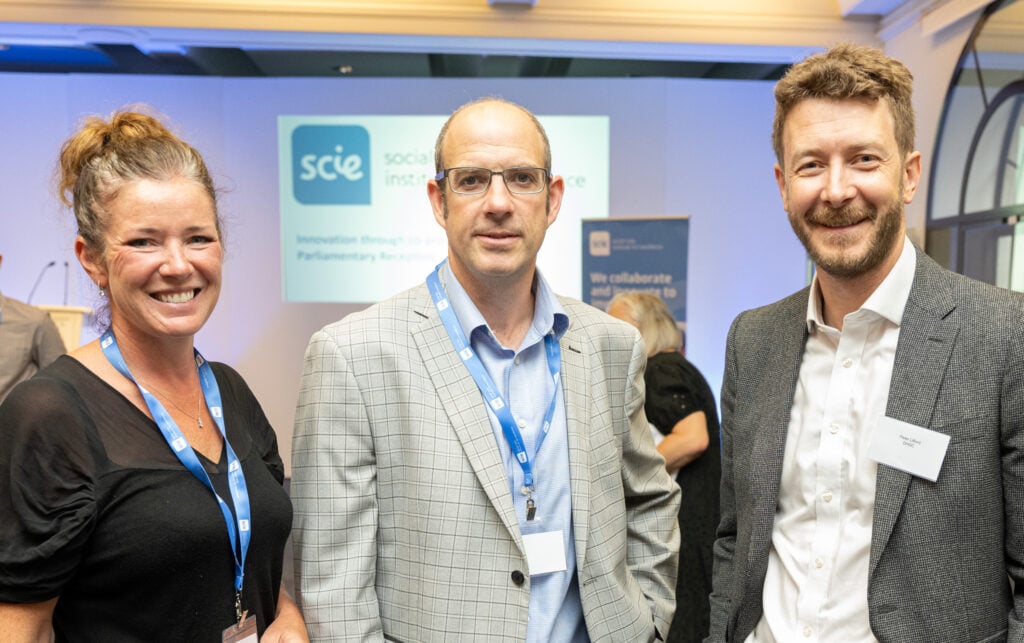
As a not-for-profit independent and impartial charity, we are driven by improving social care for adults and children, and bring a wealth of trusted, evidence-based expertise to work collaboratively to help transform care.
We’ve been working in partnership for over 25 years with a range of social care organisations to achieve maximum impact through our consultancy, training, insights and resources offers, so it’s essential we measure this and support others to do so. We are proud to share these joint achievements and the difference we are making together on the ground in our Impact Report for 2025/26.
“Genuine experts in social care, SCIE brings strategic expertise and knowledge to improve practice.” – SCIE stakeholder
“Your involvement and guidance… has strengthened our thinking and challenged us to approach this work vigorously and creatively.” – Local authority Director of Services
If you are wondering how to engage with any of the areas explored in our Impact Report and would like advice, guidance or simply an exploratory chat on these or any other challenges you face, please get in touch
SCIE offers bespoke training courses which can be delivered to your organisation or team. The courses can take place face to face at your premises or be delivered remotely using virtual training tools (e.g. Microsoft Teams, Zoom or GoToTraining).
SCIE provides training in the following areas:


Improve your own or your staff’s frontline knowledge, skills and practice in health and social care with the latest e-learning courses from SCIE.
These resources offer free, exploratory sessions to expand users understanding of Get me to Hospital and Legal Literacy. They do no not include marked assessments or certificates upon completion and will require being logged into a your free MySCIE account to use.
What is it about? Understanding when and how to use the Mental Capacity Act (MCA) to respond to situations where a person may require emergency physical health treatment but refuses to be taken to hospital. Who is it for: Practitioners, families, and individuals.
Full detailsWhat is it about? Various legal frameworks involved in the process of safeguarding adults and aims to give participants deep insights that will encourage them to consider how the legislation applies in different scenarios. Who is it for? Professionals working in the field of Adult Social Care.
Full detailsWhat is it about? Explore what safeguarding adults means and how to manage it effectively. Who is it for? All frontline health and social care staff.
Full detailsWhat is it about? Explore what safeguarding adults means and how to manage it effectively. Who is it for? For people who don’t work in social care
Full detailsWhat is it about? Explore what safeguarding adults means and how to manage it effectively. Who is it for? All frontline health and social care staff.
Full detailsWhat is it about?
Explore the MCA 2005 and how to support people to make their own decisions.
Who is it for?
All staff who look after or care for someone.
Our DOLs course is down for the moment, as we update it to reflect the Supreme Court ruling on 2 June. Please see our webinar for an overview.
Watch webinar recordingWhat is it about? Learn about what dementia is and how to live with it. Aligned with Tier 1 of the National Dementia Training Standards Framework. Who is it for? All staff who work with people living with dementia.
Full detailsWhat is it about? Study the 15 care standards set by the CQC. Who is it for? All staff working in health or social care.
Full detailsWhat is it about? Explore what DSI means, how to recognise it, and what practical approaches can help Who is it for? All social care professionals and those receiving social care support.
Full detailsWhat is it about? Deep dive into the national eligibility threshold and criteria for adults requiring care and support, and carers requiring support. Who is it for? Social care practitioners, social workers, occupational therapists and ‘third-party’, ‘community’ or ‘trusted’ assessors.
Full detailsWhat is it about? Explore reablement, how it differs from home care and intermediate care, and why and how the service should be delivered. Who is it for? Frontline health and social care staff, including home care staff.
Full detailsWhat is it about? Explore independent advocacy under the Care Act 2014 Who is it for? All social care staff, including those working in initial contact centres.
Full detailsWhat is it about? Explore what personalisation means, why it is important and what it looks like put in practice. Who is it for? All social care professionals and those receiving social care support.
Full detailsWhat is it about? Explore the SEND Code of Practice 2015 and how it influences the way support is provided for children with special educational needs and disabilities. Who is it for? Professionals who work with children with SEND.
Full detailsWhat is it about? Understand what a one-page profile is, and how to complete one, to help you achieve excellent person-centred care. Who is it for? All social care professionals and those receiving social care support.
full detailsTraining and remote learning options from SCIE
Our courses help providers and their staff to develop an understanding of the responsibilities and duties under the Mental Capacity Act 2005 (MCA). This essential training is for professionals involved in care, treatment and support of adults who may lack capacity to make decisions.
Our training offers vital support for social care providers to ensure that they comply with legislation, the Care Quality Commission requirements, and promote human rights. Further assistance can also be offered to organisations through consultancy.
Work with SCIE to develop your digital offer to your social care workforce and the people who use your services
If you’re wondering how to engage with digital transformation and innovation, and would like advice, guidance or simply an exploratory chat on digital innovation or other challenges you face, and how we can support you, please contact us.
SCIE recognises the key drivers behind digital transformation and the current challenges facing adult social care:
SCIE employs a four-stage, appreciative approach. We work collaboratively with teams to build trust, strong team working and capability.
Including senior sponsorship and a practice study team to drive our analysis.
Through a practice study comprising data from: day in life of stories; practice insight; reflective learning; and lived experience.
Translating the practice study insights into a robust case for change and planning.
To produce a next-steps plan for sustaining change.
Our team brings the expertise to: