

Reducing unfair and avoidable differences in social care.
Introduction
Care equity is about fairness in health and social care. It means people can access the care they need, when they need it, regardless of who they are or where they live.
At the Social Care Institute for Excellence (SCIE), we use care equity as a way to understand and address differences in access, experience and outcomes across the system.
This page introduces what we mean by care equity, how we explain it in accessible ways, and how we analyse it through our dimensions of inequity framework.
You can also explore our Care Equity Evidence Hub.
What we mean by care equity
This includes:
- Access: Can you get the right care, in the right place, at the right time, when you need it?
- Experience: Is care delivered in a way that respects your needs, preferences and circumstances?
- Outcomes: Does the care you receive improve your quality of life, independence and wellbeing?
Care equity focuses on differences that are:
- Unfair (linked to disadvantage or discrimination)
- Avoidable (could be reduced, prevented or addressed through better policy or practice)
The definition also aligns with the core principles of personalisation, prevention and wellbeing found in the Care Act of 2014. Achieving equity means that support should be matched to individuals’ needs, and that services are designed and delivered in a way that removes barriers, reduces disadvantage, and respects people’s circumstances.
This includes, but goes beyond, access, it also covers how people are treated, whether services are inclusive and appropriate, and whether they lead to meaningful improvements in people’s lives.
A simpler definition
This means:
- You are not treated worse because of who you are
- You can get help and support where and when you need it
- The care you receive works for you
Easy read definition
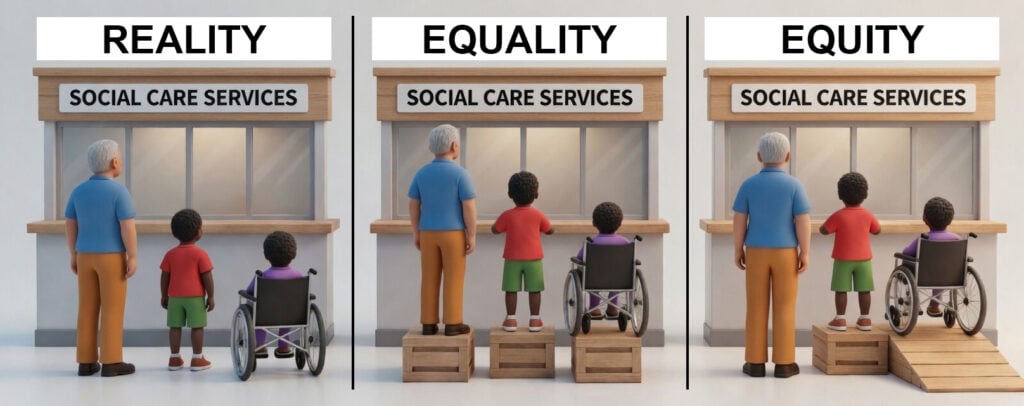
A three-panel illustration contrasting reality, equality, and equity in access to social care services. In the first panel, labelled “Reality”, a tall older man, a short child, and a wheelchair user stand at a Social Care Services counter. The man can see over it, but the child and wheelchair user cannot reach it. In the second panel, labelled “Equality”, all three are given identical wooden crates to stand on; the man and child can now see over the counter, but the wheelchair user still cannot use the crate. In the third panel, labelled “Equity”, the supports are tailored to individual need: the child has a taller step, and the wheelchair user has a sloped ramp, giving everyone equal access to the counter.
The dimensions of inequity
To understand care equity in practice, SCIE has developed a dimensions of inequity framework, often described as a ‘rainbow’.
The rainbow shows how different layers of influence interact to shape people’s access to, experience of, and outcomes from care.
These factors sit around the individual and are shaped by the wider system. They are not simply a result of personal choice.
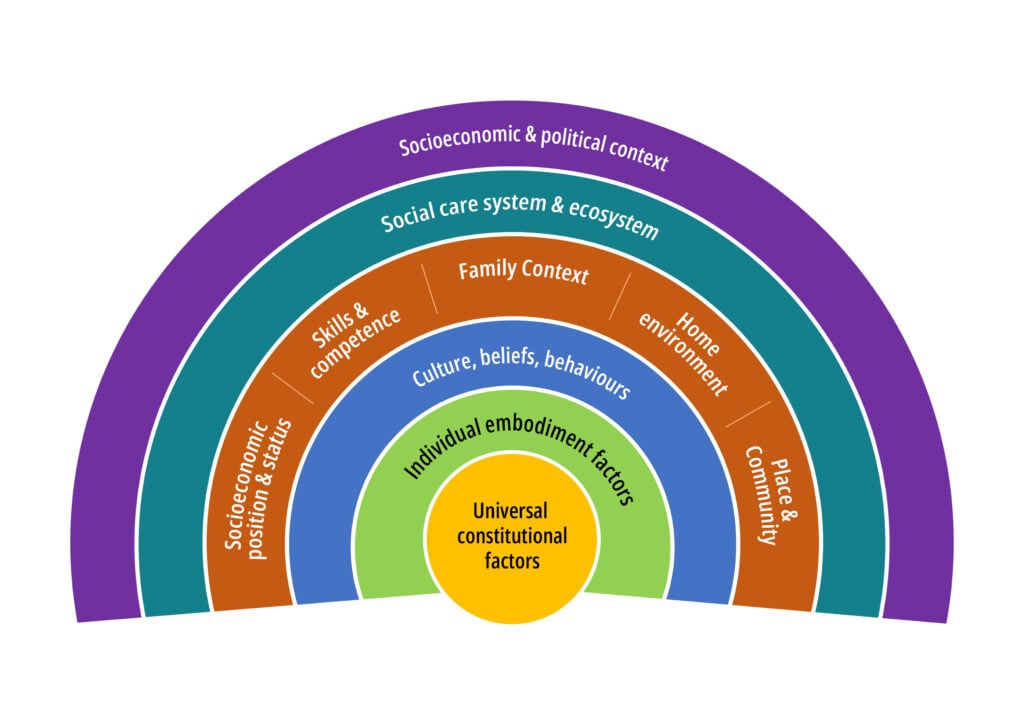
- (Purple) Socioeconomic and political context: National policy, funding, and wider inequalities
- (Teal) Social care system and services: How services are organised, funded and delivered
- (Orange) Family and home context: Living situation, support networks, caring roles
- (Orange) Place and community: Local area, infrastructure, and community resources
- (Orange) Socioeconomic position: Income, education, employment, deprivation
- (Orange) Skills and capabilities: Health literacy, confidence, ability to navigate services
- (Blue) Culture, beliefs and behaviours: Values, expectations, and experiences of care
- (Green) Individual factors: Age, disability, long-term conditions and other characteristics
- (Yellow) Universal constitutional factors (personal characteristics): The basic biological characteristics we are all born with, such as age, sex and genetic makeup
These dimensions do not act in isolation. People may experience multiple, overlapping forms of disadvantage. Differences in care do not happen by chance. They are shaped by how systems are designed and how resources are distributed.
This means:
- Inequities are often system-driven
- They can be identified and addressed
- Responsibility sits with services, policy and practice, not individuals
How to use the framework
The framework can help you:
- Identify where inequities exist
- Understand who is most affected
- Explore the causes of differences in care
- Inform more equitable service design and policy
It supports a more structured approach to analysing care equity across health and social care.
Explore the evidence
This page is an introduction to care equity as one of SCIE’s insight topics.
You can explore the full evidence base, including:
- Research summaries
- Data analysis
- Commentary on inequalities in care
Why care equity matters
Differences in care are well documented across health and social care.
For example:
- People in more deprived areas often have worse access to services
- Some groups report poorer experiences of care
- Outcomes can vary widely depending on location, income, or identity
These differences are not inevitable. Many are shaped by how services are designed and delivered.
Addressing care equity helps:
- Improve outcomes for people using services
- Support a fairer system
- Make better use of resources
Work with us
SCIE works with partners across health and social care to improve equity in practice. Get in touch if you are interested in:
- Applying the framework
- Understanding inequities in your area
- Designing more equitable services