
3 July 2026
By Dr Clenton Farquharson CBE, Associate Director, Think Local Act Personal (TLAP)
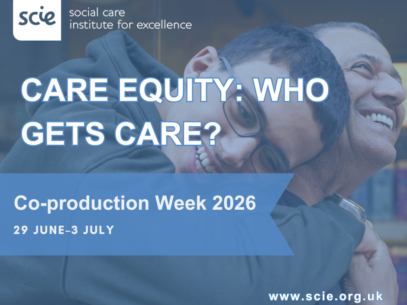
Our Co-production Week theme, care equity, starts with a simple question, but one of the most important in social care: who gets care?
This is a chance to ask and expand on this: who gets care and who is still being left out?
It is a simple question, but not a comfortable one.
Across social care, people with similar needs can have very different experiences. One person may get timely, flexible support that helps them live well. Another may face delays, unclear information, services that do not understand their circumstances or support that arrives too late.

Sometimes the difference is shaped by where someone lives. Sometimes it is shaped by income, ethnicity, disability, age, gender, digital access, language, housing, family networks or how confident someone feels navigating the system.
That is why care equity matters.
Care equity means that no one should receive worse care, or miss out on care, because of who they are, where they live or the circumstances of their life. It means looking honestly at the gaps in access, experience and outcomes and doing something practical about them.
The Care Equity Evidence Hub has been developed to help with that task. It brings together research, data, case studies and analysis on inequities in social care, which have importantly been reviewed by SCIE, so that people across the sector can better understand where unfairness shows up and what might help to address it. SCIE created the Hub as a resource to support policy, practice and service design by making evidence easier to find, understand and use.
But evidence on its own is not enough.
Evidence can show us patterns. It can tell us that people in different places, from different communities, or with different financial circumstances may have different experiences of care. It can help identify where systems are not working as they should. But evidence does not always tell us what it feels like to be on the receiving end of those systems.
That is where co-production is essential.
Co-production brings people who draw on care and support, unpaid carers, practitioners, researchers, commissioners and organisations into the work as partners. It recognises that lived experience is not a nice addition to the evidence base. It is part of the evidence base.
When people with lived experience are involved, different questions get asked.
Not just: what does the data say?
But also: whose experience is missing? Who finds this system hardest to use? What assumptions are built into the way support is designed? What would make this evidence useful to people making decisions? What would make it useful to people living with the consequences of those decisions?
That shift matters because inequity is not always obvious from a spreadsheet or a report. It can appear in the gap between having a service and being able to access it. It can appear when digital systems are introduced without proper alternatives. It can appear when transport, language, culture, cost or trust are treated as side issues rather than central parts of whether care works.
Evidence tells us where to look. Co-production tells us what it means.
This year’s theme is the right question at the right time. SCIE and the Co-production Steering Group has set out the week to explore how co-production can help achieve better equity in care, demonstrate its impact and improve people’s experience of co-production in social care.
For us, that question leads to another.
Who gets to shape care?
If the answer is only professionals, organisations or institutions, then we will keep missing things.
We will miss the quiet barriers. We will miss the people who have learned not to complain. We will miss the communities who have not been invited into the room. We will miss the difference between a service being available and a service being genuinely accessible.
The future of care has to be shaped with the people who draw on it, care for others, work in it, commission it, research it and live with its consequences.
The Care Equity Evidence Hub is one contribution to that future. Its value will grow if people use it, challenge it, add to it and share what they are learning.
Because fair care does not happen by accident.
It happens when we ask better questions, listen to different voices, and use evidence not just to understand the system, but to change it.
Evidence tells us where to look.
Co-production tells us what it means.
Together, they can help us build care that is fairer, more consistent and more human.
If you would like help to improve your co-production approach, please contact consultancy@scie.org.uk to hear more about how SCIE can support you.
And view the Care Equity Evidence Hub here. We need you to share feedback on the hub, suggest new evidence topics, identify gaps in the current evidence base, or provide examples of how evidence has been used to inform policy or practice.