
Active resistance
- Arguing
- Ridiculing
- Blaming
- Complaining
- Distorting
- Blocking
- Refusing
This website will offer limited functionality in this browser. We only support the recent versions of major browsers like Chrome, Firefox, Safari, and Edge.
Another striking statistic regarding change programmes is that 70 per cent of the reasons that they fail are cultural (NHS, 2009). Schneider and Barbera (2014) define organisational culture as: ‘the values and beliefs that characterise organisations, as transmitted by socialisation processes that newcomers have, the decisions made by management, and the stories and myths people tell and retell about their organisations’ (p. 10). This reflects that staff members are inducted into the culture of the organisation through socialisation, and that culture is developed and reinforced by the decisions and actions taken, and the informal anecdotes and personal reflections by individuals and within teams. Bissell (2012, p.82) provides a simpler account. He argues that it is ‘deeply held beliefs about success’ which underpin culture, which underlines the sense that culture is something that can be resistant to change through the strength of attachment. Further it relates to what ends are aspired to (i.e. why we do what we do) as well as the processes through which these can be achieved (i.e. the way we do things around here).
The culture of an organisation can foster resistance to change by the staff members and other stakeholders. Resistance to change arises from a number of factors (Holt et al 2007, Landaeta et al 2008) including:
Resistance can take both active and passive forms. Whilst active forms can feel more challenging, it is often the more implicit form of resistance that can be hardest to address. Those leading the change may not fully be aware of this passive resistant behaviour and the concerns that lie behind it. It is also important to remember that concerns regarding a change may be valid – involving the different stakeholders throughout the process will help to identify issues and potential solutions.
Table: Active and passive resistance to change
Active resistance
Passive resistance
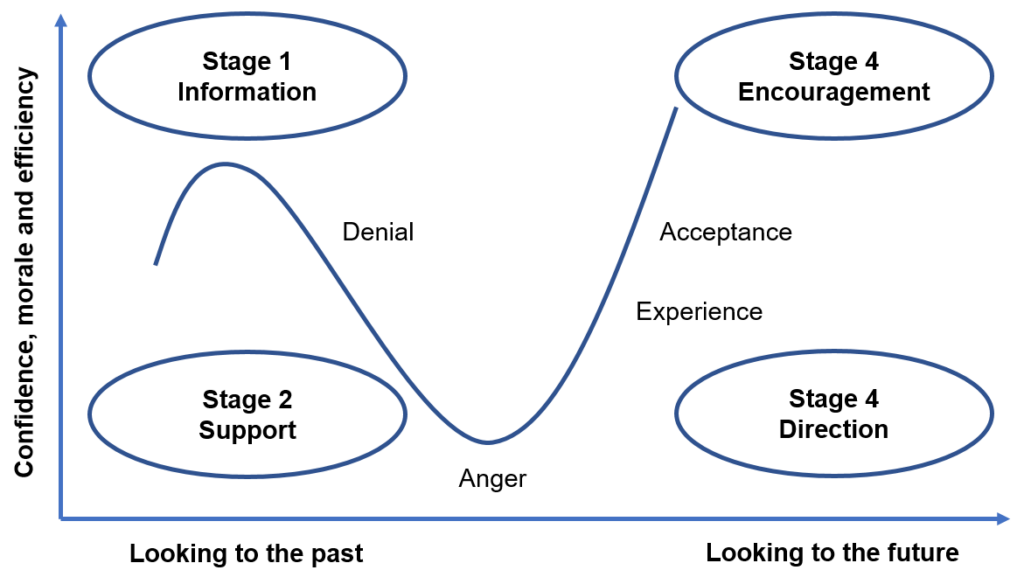
We can all experience strong emotions to a change in our work or personal lives. This can be positive when it relates to a new and beneficial opportunity, or if an existing stress in our lives is removed. Change can be extremely difficult though if it is not something that we agree with or results in the loss of something valued. The intensity of emotions that we can experience reflects the grief process outlined in the Kubler Ross Curve. Leaders can tailor their support to reflect the stage of loss commonly experienced – information at the stage of denial, emotional support during anger, vision and direction when exploring the new reality, and encouragement when there is acceptance of the change (Wiggins, 2008).
Figure 4: Kubler Ross Curve and organisational change
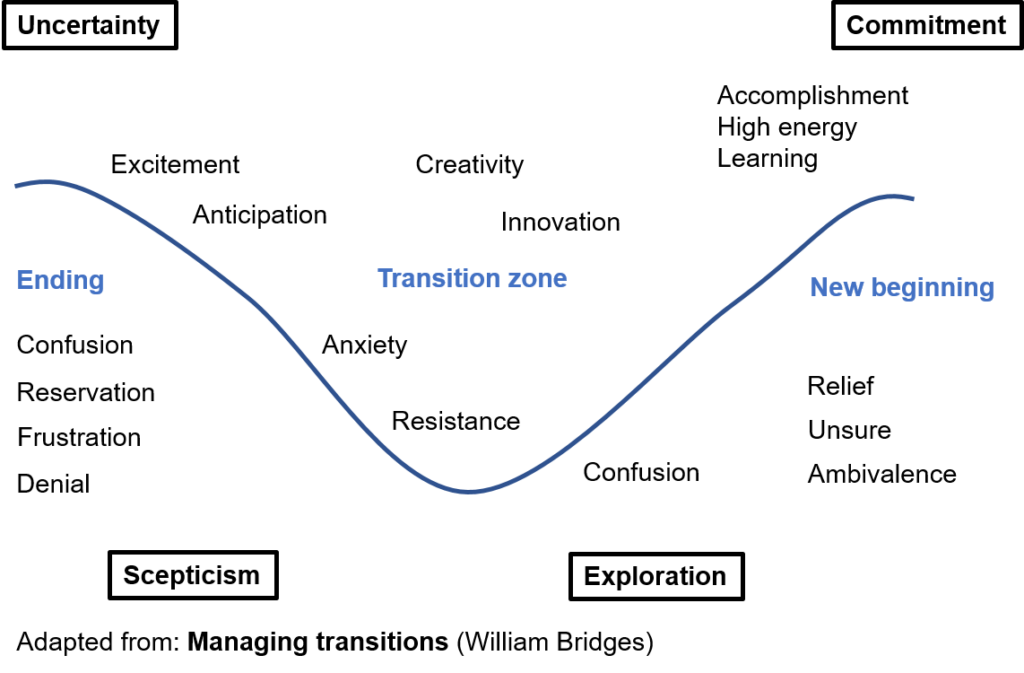
Another model to understand emotional responses to change is the Transition Model (Bridge, 1986). This differentiates between change – ‘when something starts or stops, or when something that used to happen in one way starts happening in another’ (p.25) – and transition – ‘a three-part psychological process that extends over a long period of time and cannot be planned or managed by the same rational formulae that work with change’ (p.25). Transition begins with an ‘ending’, in which we have to let go of what has happened previously, and the associated identity and self-worth. There is then a ‘neutral zone’, in which the future can be uncertain and feelings of hope can alternate with despair and anxiety. The final stage is that of a ‘new beginning’, when we become comfortable with what is expected of us, and develop the necessary competences. This is associated with a new sense of purpose and confidence in our reborn identity. Understanding this process can enable leaders to positively support people through this transition (Bridges and Mitchell, 2000).
Figure 5: Bridges’ Transition Model
For more information
Watch Five ways to lead in an era of constant change (Jim Hemerling, TED Talks, 2016) on the importance of person-centred leadership approaches to organisational change.
All of us connect with the world in two ways. Firstly, through applying our rational thoughts to analysing the world to establish patterns, identify cause and effects, and test relationships. Secondly, through responding emotionally to what we experience, what we are told, and what we fear or hope may happen (Bruner 1986). Motivating people to act requires connection therefore with their ‘heads’ (through strategy) and through their ‘hearts’ (through storytelling). Stories are a powerful determinant of organisational culture as they shape what we see as important within its history and help us to frame our current reality (Johnson et al 2009). They achieve this through being compelling (we want to hear the ending), appealing to our values and emotions, being social experiences (we listen to them with others and/or they are about other people) and by simplifying complexity. Stories will often suggest that there is a correct (and a wrong) way to respond to the situation or issue about which they are telling (Lawrence-Pietroni and Needham, 2019).
Stories are therefore an important means through which leaders can inspire others to participate in a change. Public Narrative framework was developed by Marshall Ganz to help guide how such stories can be structured by leaders. He worked within the civil rights movement in America before supporting Barack Obama to win the presidency. His framework comprises three interlocking stories (Ganz, 2010). The story of self draws on the speaker’s personal experiences and values to communicate why they are motivated to support an initiative or address a challenge. The story of us involves the speaker helping those listening to understand why this issue or challenge is relevant to all of them too. Finally, the story of now builds a sense of urgency as to why it is imperative to do something now and the negative consequences of not acting. Public narrative stories can motivate people to give their moral and practical support to a common cause.
For more information
Watch Public narrative (Marshall Ganz, 2015) in which Marshall Ganz talks about ‘the story of self, now and us’, and Fire it up! Ready to go! (Barack Obama, 2009), an example of public narrative in practice by Barack Obama.
Read this helpful resource which considers how storytelling can be used to support systems change.
Watch Examples of public narrative from past programme participants
This is a community project in Barking and Dagenham, run by the local authority’s Adult Social Care Service. Songs written and produced based on the stories of residents can be heard on Soundcloud.
Co-production is a key concept in the development of public services. Co-production recognises that people who use services often have fewer resources and less influence than professionals. It is a way of sharing influence and decision-making and creating services that work for the people they’re designed for. The role of co-production in the health and social care field has been recognised more and more in recent years, both nationally and internationally. The Care Act 2014 is one of the first pieces of legislation to specifically include the concept of co-production in its statutory guidance. In particular, it states that co-production should be used to develop preventative, strengths-based services, support assessment, shape the local care market and plan information and advice services.
There is no one definition of co-production, but some commonly used ones are provided below:
The range of definitions which have been developed for co-production can be confusing, and what is missing is any reference to working with professionals, partners and staff in equal partnership. However, there are some key features that tend to be present in all transformative co-production initiatives:
Given the varying definitions and absence of any one roadmap to co-production, many commentators have argued that it is useful to approach co-production as a set of distinctive principles. The following principles of equality, diversity, accessibility and reciprocity are critical values for putting co-production into action.
Co-production provides the opportunity to transform health and social care provision into a way of working that offers people real choice and control. It is therefore recognised as being a core approach to implementing personalised care for everyone. Similarly, co-production with its focus on collaboration and its emphasis on people as assets is also closely linked to the successful implementation of strengths-based practice.
The reported benefits associated with co-production are wide ranging:
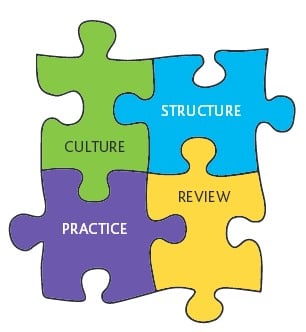
Co-production has a big role to play in leading transformative change. It calls for an emphasis on distributed and/or collective leadership, working across boundaries, a focus on relationships rather than organisational structure, to facilitate the development of co-produced solutions, plans and services. To ensure that co-production is embedded in an organisation, leadership needs to take a whole systems approach which can seem like pulling a jigsaw together. As described below, for co-production to work effectively, leaders need to ensure that change will happen in each piece of the jigsaw.
Figure 6: The co-production puzzle
For more information
Oxfordshire co-production handbook – Co-production Oxfordshire is a group of people committed to doing co-production, or working together. It believes that if we work together, we can make services better and more sustainable, and communities stronger and healthier. Co-production Oxfordshire, with the support of SCIE, developed a handbook to help other organisations developing co-production arrangements to think through how they would do this.